Best Decaf Instant Coffee in 2026
 Tommie Chaney·
Affiliate disclosure: Sweeter Grind is a participant in the Amazon Services LLC Associates Program. We may earn commissions on qualifying purchases at no extra cost to you.
The best decaf instant coffee for most people is Mount Hagen Organic Freeze Dried Instant Decaf, at $14.99 and roughly $0.30 a cup as of September 2026. It is freeze-dried, and it is the only product here that states how the caffeine was removed. Those two facts matter more than the brand on the label.
Instant decaf is not a worse version of brewed coffee. It is a different product: coffee brewed, concentrated and dried in a factory, then rehydrated in your mug. What separates a good jar from a flat one is the drying method, not the name. That is why a $14.99 jar can beat an $8 one, and why a $1.02 Starbucks packet does not automatically beat either. If you are still weighing up decaf in general, start with our decaf coffee guide.
Six jars and packet boxes below, ranked on the arithmetic nobody else runs.
Our Picks at a Glance
| Pick | Product | Size / count | Price | Cost per cup | Process named? |
|---|---|---|---|---|---|
| Best Overall | Mount Hagen Organic Freeze Dried Instant Decaf | 3.53 oz jar, approx 50 cups | $14.99 | ~$0.30 | Yes, CO2 |
| Best Single-Serve Sticks | Mount Hagen Single Serve Decaf Packets | 25 sticks, 1.76 oz | $12.99 | ~$0.52 | Yes, CO2 |
| Best Organic Alternative | Highground Organic Instant Decaf | 3.53 oz jar, 40+ cups | $13.99 | ~$0.35 | No |
| Best for Milk Drinks | NESCAFE Gold Decaf Espresso | 3.17 oz jar, up to 50 cups | $9.97 | ~$0.20 | No |
| Best Budget | Maxwell House Original Roast Decaf | 8 oz jar, 120 cups | $7.99 | ~$0.067 | No, states "99.7% caffeine free" |
| Best Dark Roast Packets | Starbucks VIA Instant Decaf Italian Roast | 20 packets | $20.37 | ~$1.02 | No |
Prices are as of September 2026 and move. Cup counts are maker claims from each listing; the cost-per-cup column is our arithmetic on those claims.
Freeze-Dried Versus Spray-Dried: The Only Spec That Matters
All instant coffee starts the same way. Roasted coffee is brewed at industrial scale, and that liquid is dehydrated by one of two methods, as Wikipedia's overview of instant coffee manufacturing sets out. Everything you taste downstream follows from which one a factory used.
Spray drying atomises the extract into hot gas, producing dust-sized particles around 300 micrometres across in as little as 5 to 30 seconds. Wikipedia notes it is cheaper to produce, and preferred to freeze-drying in some cases because it allows larger-scale economic production and shorter drying times. The cost of that speed is heat, and heat drives off the volatile compounds that make coffee smell like coffee.
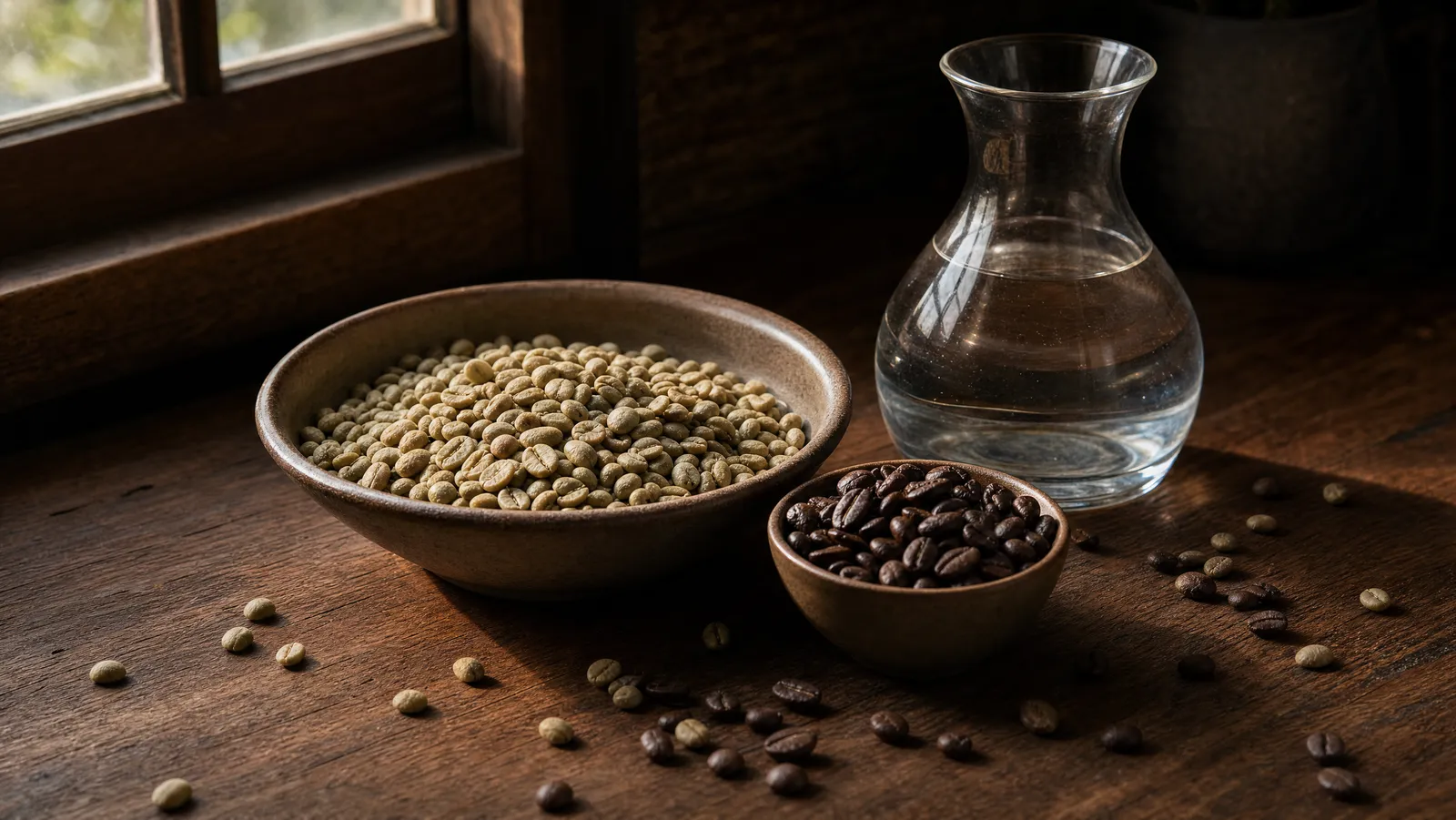
Freeze drying takes the long way round. The extract is frozen, milled into granules and held in a vacuum where the ice sublimates straight to vapour, skipping the liquid phase and the high temperatures that degrade character. Sucafina Instant, which supplies both formats to manufacturers, describes freeze-dried coffee as having "a clean, crisp flavour with brighter top notes", and says producing it uses three to five times more energy than spray drying.
Sucafina frames this as different rather than better: it credits spray-dried coffee with "a rounder, fuller body and a smoother mouthfeel", says it resists humidity better, and notes it "often performs better in mixes with milk, sugar, flavours or creamers". That nuance is real. But if you drink decaf black, freeze-dried is the word to look for on the jar.
Best Overall: Mount Hagen Organic Freeze Dried Instant Decaf Coffee
Mount Hagen wins because it answers both questions this category dodges. The jar is explicitly freeze-dried, and the brand states a patented CO2 decaffeination process extracting 99.99% of the caffeine. No other listing here names a process at all.
That matters because CO2 is the gentlest of the common methods. A technical review of supercritical carbon dioxide decaffeination in Chemical Engineering Transactions describes beans steamed to swell them, then held under supercritical CO2 at around 250 bar while caffeine migrates out; CO2 is highly selective for caffeine and takes comparatively little else with it.
The coffee is 100% Arabica, medium roast, from the Mount Hagen region of Papua New Guinea, and the brand says it dissolves in cold water as well as hot. It carries USDA Organic, Fairtrade, gluten-free and OU Kosher claims. One caution: the listing also boasts that it "consistently tops lists of best instant organic coffees", which is unverifiable and not something we will repeat as fact.
At $14.99 as of September 2026 for 3.53 oz, this is $4.25 an ounce, or near $0.30 a cup on the stated yield of about 50 cups. Check the current price before committing.
Best Single-Serve Sticks: Mount Hagen Single Serve Instant Decaf Coffee Packets, 25 Count
The same freeze-dried Papua New Guinea Arabica and the same stated CO2 process, in 25 sealed sticks totalling 1.76 oz. Mount Hagen positions them for a backpack, briefcase or office desk, and says they dissolve in cold water or milk for iced coffee.
The format solves a real problem. Sucafina Instant points out that freeze-dried coffee "keeps top notes longer before opening, but once the jar is opened, aromatics escape relatively quickly". A sachet is a jar that stays shut until the moment you drink it.
You pay for that. At $12.99 as of September 2026 the sticks are about $0.52 each and roughly $7.38 an ounce, the highest price per ounce here by a wide margin — you are buying packaging, not better coffee. Fair for a commute or a campsite, poor value on a counter. For the caffeinated outdoor equivalent, see best instant coffee for camping. Current stick pricing.
Best Organic Alternative: Highground Organic Instant Decaf Coffee
Highground is the sensible second choice if Mount Hagen is out of stock or you want to rotate jars: a 3.53 oz resealable jar of freeze-dried 100% Arabica, medium roast, which Highground describes as organic and Fair-Trade certified, in a jar it says is 30% recycled material. It dissolves in hot or cold water, per the brand.
The gap is the decaffeination method: Highground names none, and we will not infer one. That is the single most informative thing a decaf producer can print, so its absence counts against an otherwise well-specified jar. If you care how the caffeine comes out, how decaf coffee is made covers the methods in use.
At $13.99 as of September 2026 the jar is $3.96 an ounce, and on the stated 40-plus cups that is roughly $0.35 a cup — slightly dearer per cup than Mount Hagen despite the lower shelf price. That inversion is exactly what the cost-per-cup column exists to catch. See the current jar price.
Best for Milk Drinks: NESCAFE Gold Decaf Espresso Instant Coffee
First, the correction. This is not espresso. There are no nine bars of pressure anywhere in the process; it is an instant formulated to behave like an espresso base. Nescafe is reasonably clear in its own instructions: scoop one teaspoon and add 2 fl oz of water for a decaf espresso, or 6 fl oz for an Americano.
Set the name aside and it is a good option for one job. Nescafe describes a cafe-style crema and a velvety texture from golden-roasted Arabica, and the product is meant to be diluted or cut with milk rather than drunk as a long black — which fits Sucafina's point that instant built for milk and sugar mixes is formulated differently from instant built to be drunk black. Nescafe states neither a drying method nor a decaffeination process.
At $9.97 as of September 2026 for 3.17 oz it is $3.15 an ounce, and on the claim of up to 50 cups prepared as directed, roughly $0.20 a cup — the cheapest jar here outside the budget pick. Check price and availability.
Best Budget: Maxwell House Original Roast Decaffeinated Instant Coffee
Nothing else here comes close on cost. Maxwell House states the 8 oz jar makes 120 cups, which at $7.99 as of September 2026 (down from a $9.99 list price) is about $0.067 a cup, or one dollar an ounce. The jar is certified Kosher and Kosher for Passover, and Maxwell House says the brand has been roasting in the USA since 1892.
Two honest caveats. The listing does not say how the coffee is dried, and it does not claim freeze-drying, which is itself informative. We will not assert a drying method the maker has not stated, but the missing word is a signal.
Second, the caffeine claim is softer. Maxwell House states "99.7% caffeine free"; Mount Hagen states 99.99% of caffeine extracted. Both are maker claims rather than independent measurements, and the difference is not a rounding artefact — 99.7% leaves thirty times the residual caffeine that 99.99% does from the same starting point, 0.3% against 0.01%. Both clear the US threshold comfortably: Swiss Water notes that at least 97% of the caffeine must be removed for coffee to be labelled decaf in the US, while the EU works to a 0.1% residual limit in roasted coffee under Directive 1999/4/EC. If that gap matters to you, does decaf coffee have caffeine has measured numbers rather than marketing ones. Current jar price.
Best Dark Roast Packets: Starbucks VIA Instant Decaf Italian Roast, 20 Packets
If you want a dark roast, this is the only one on the list. Starbucks describes the Decaf Italian Roast as a decaffeinated dark roast with sweet undertones leading to a depth of flavour, with notes of dark cocoa and toasted marshmallow, from the same Arabica beans brewed in its cafes. No decaffeination process is named and no drying method is disclosed.
The format is the appeal: 20 sealed packets survive a suitcase and need only a hotel kettle. The price is the problem. At $20.37 as of September 2026 that is about $1.02 a cup, roughly fifteen times the Maxwell House cup. A dark-roast preference and portability justify paying it. A belief that you are getting cafe espresso in a sachet does not. See the current box price.
Cost Per Cup: The 15x Spread Nobody Mentions
Shelf price tells you almost nothing here, because pack sizes and stated yields differ wildly. Divide each price by each maker's own cup claim, as the table above does, and the range runs from about $0.067 a cup for the 120-cup Maxwell House jar to about $1.02 for a Starbucks VIA packet, on prices as of September 2026.
From $0.067 to $1.02 is a fifteen-fold difference for the same decaffeinated cup, and shelf price predicts it badly: Highground is a dollar cheaper than Mount Hagen but five cents dearer per cup, and the Mount Hagen sticks cost nearly twice as much per cup as the identical coffee in a jar.
Now the tension, which we would rather name than bury. Instant coffee is hygroscopic. Cartograph Coffee describes the granules as "tiny, super-thirsty sponges" that pull moisture from the air, clump and lose quality, and notes that something as small as a damp spoon starts the process. Sucafina Instant adds that freeze-dried aromatics escape relatively quickly once the jar is opened.
So a 120-cup jar only costs seven cents a cup if you drink 120 cups before it goes dull. For one person having a single evening cup, that is four months of exposure to kitchen air. Small jars beat bulk for most households, even though bulk wins the spreadsheet.
Instant Decaf Versus Brewed Decaf
Instant decaf has a real and permanent ceiling, and pretending otherwise would cost us your trust. You are rehydrating coffee that was brewed, concentrated and dried in a factory, from beans that had already given up some flavour precursors during decaffeination. Two rounds of processing sit between crop and mug.
What you get back is convenience and consistency. What you do not get back is the aromatic top end of a bag ground that morning. No jar on this list beats a decent decaf brewed on a V60, and none is trying to. If you want the real thing, read the best decaf coffee beans instead, where to buy fresh specialty decaf for the channels that will actually get a roast date onto the bag, and why decaf tastes different and how to brew it for the technique decaf beans need.
Instant wins where brewing is not on offer: a hotel room, an office with a kettle and no grinder, a tent, a long flight, a 9pm cup you do not want to make a project of. There it is not a compromise on brewed decaf. It is a compromise on no coffee, and it wins that comparison easily.
How to Make Instant Decaf Taste Better
Instant responds to technique more than its reputation suggests.
- Use water just off the boil, not boiling. The granules are already extracted, so there is nothing left to pull out of them. Boiling water only volatilises the aromatics you paid extra for.
- Slurry the granules in cool water first. Stir them into a teaspoon or two of cool water until dissolved, then top up with hot. It avoids scalding them and kills the specks that float on top.
- Dose by weight, not by "a teaspoon". Freeze-dried granules and fine crystals have very different densities, so a level teaspoon of one is not the same mass as a level teaspoon of the other. Weigh 2 g and adjust from there.
- Keep the jar sealed and the spoon dry. Cartograph Coffee's damp-spoon warning is the easiest mistake to fix. Do not decant into anything that does not seal.
- Do not store it above the kettle. Warmth plus steam is the worst spot in the kitchen for a hygroscopic powder; the logic in how to store coffee beans for freshness applies here too.
- Try it iced. Both Mount Hagen products and Highground state that they dissolve in cold water, and cold serving forgives a thinner aromatic profile.
Frequently Asked Questions
Is freeze-dried instant decaf actually better than spray-dried?
For black coffee, it generally holds more aroma. Freeze drying removes water by sublimation under vacuum, avoiding the heat that drives off volatile compounds, and Sucafina Instant characterises the result as a clean, crisp flavour with brighter top notes. Sucafina also counters that spray-dried instant has a rounder body and does better in milk and sugar mixes. So it is better for the way most specialty drinkers take decaf, not universally better.
How much caffeine is left in decaf instant coffee?
Not zero, but very little. Swiss Water puts a standard 8 oz cup of decaffeinated drip coffee at roughly 2 to 15 mg, against a Wikipedia-cited median of about 66 mg for a cup of regular instant and 112 mg for drip. Instant decaf sits at the low end, since instant starts from a lower caffeine base than filter coffee.
Does "99.7% caffeine free" mean the same thing as 99.99%?
No, and the gap is larger than it looks. Maxwell House states 99.7% caffeine free while Mount Hagen states a CO2 process extracting 99.99% of the caffeine, implying roughly thirty times more residual caffeine in the first, 0.3% against 0.01%. Both are maker claims rather than laboratory measurements, and both clear the US labelling threshold Swiss Water describes, under which at least 97% of the caffeine must be removed for coffee to be sold as decaf.
Is Nescafe Gold Decaf Espresso real espresso?
No. Espresso is defined by pressure, conventionally around nine bars, and no instant coffee involves any. Nescafe Gold Decaf Espresso is an instant formulated as an espresso base, as its own directions make clear in telling you to dissolve a teaspoon in 2 fl oz of water. Good for milk drinks and Americano-style cups; not a shot.
How long does instant decaf last once the jar is open?
Longer than ground coffee, but not indefinitely, and the enemy is moisture rather than time. Cartograph Coffee describes instant granules as hygroscopic sponges that clump and lose quality as they pull water from the air, and Sucafina Instant notes that freeze-dried aromatics escape relatively quickly after opening. Buy a size you will finish in a month or two and use a dry spoon.
Are single-serve decaf sachets worth the premium?
Only for the situations that justify them. Mount Hagen's 25 sticks cost about $0.52 a serving against roughly $0.30 for the same coffee from the jar, as of September 2026. The premium buys sealed portions that never sit open to kitchen air — worth real money in a suitcase, nothing at all on your own counter.
Conclusion
If you want one jar and no further thinking, buy the Mount Hagen freeze-dried jar: it names its process and $0.30 a cup is fair. If cost decides it, Maxwell House at about seven cents a cup is unbeatable arithmetic, provided you buy a size you will finish. If you travel, pay the sachet premium. And if the jar is really a stand-in for something better, our guide to decaf coffee points you at whole beans worth grinding.
Related reading
- The best decaf coffee beans
- Where to buy fresh specialty decaf
- Does decaf coffee have caffeine
- How decaf coffee is made
- Why decaf tastes different and how to brew it
- Best instant coffee for camping
- How to store coffee beans for freshness

Mount Hagen Organic Freeze Dried Instant Decaf Coffee
A 3.53 oz (100 g) jar of freeze-dried instant decaf made from 100% Arabica grown in the Mount Hagen region of Papua New Guinea. It is the only product in this roundup that names its decaffeination method: Mount Hagen states a patented CO2 process that extracts 99.99% of the caffeine. At $14.99 as of September 2026 against the maker's claim of roughly 50 cups per jar, that works out near $0.30 a cup.

Mount Hagen Single Serve Instant Decaf Coffee Packets, 25 Count
The same freeze-dried Papua New Guinea Arabica as the jar, portioned into 25 single-serve sticks totalling 1.76 oz (50 g). Mount Hagen states the same patented CO2 decaffeination process extracting 99.99% of the caffeine, and says the sticks dissolve in cold water or milk. At $12.99 as of September 2026 that is about $0.52 a stick, or roughly $7.38 an ounce.

Highground Organic Instant Decaf Coffee
A 3.53 oz resealable jar of freeze-dried instant decaf from 100% Arabica, which Highground describes as organic and Fair-Trade certified, in a jar made from 30% recycled material. The listing dissolves in hot or cold water but never names a decaffeination method. At $13.99 as of September 2026 against a stated 40-plus cups, that is roughly $0.35 a cup.

NESCAFE Gold Decaf Espresso Instant Coffee
A 3.17 oz jar of instant decaf formulated as an espresso base rather than actual espresso. Nescafe directs you to scoop one teaspoon and add 2 fl oz of water for a decaf espresso or 6 fl oz for an Americano, and describes a cafe-style crema from golden-roasted Arabica. The listing names neither a drying method nor a decaffeination process. At $9.97 as of September 2026 against a stated 50 cups, that is close to $0.20 a cup.
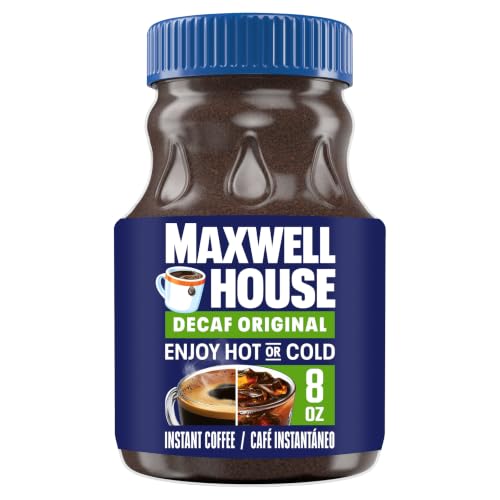
Maxwell House Original Roast Decaffeinated Instant Coffee
An 8 oz jar of instant decaf crystals, certified Kosher and Kosher for Passover, from a brand Maxwell House says has been roasting in the USA since 1892. Maxwell House states the jar makes 120 cups and that the coffee is 99.7% caffeine free; it names no decaffeination process and does not claim freeze-drying. At $7.99 as of September 2026, down from a $9.99 list price, that is about $0.067 a cup.
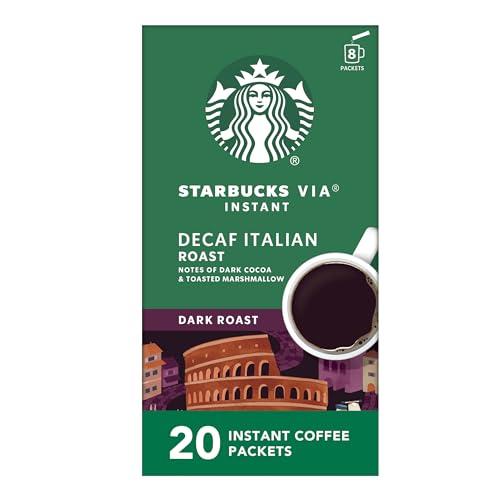
Starbucks VIA Instant Decaf Italian Roast, 20 Packets
A box of 20 single-serve packets of decaffeinated dark roast Arabica. Starbucks describes the Decaf Italian Roast as having sweet undertones with notes of dark cocoa and toasted marshmallow, made from the same beans brewed in its cafes. No decaffeination process and no drying method are named. At $20.37 as of September 2026 that is about $1.02 a packet, the most expensive cup here.