Half-Caff Coffee: How to Cut Caffeine Without Losing the Ritual
 Tommie Chaney·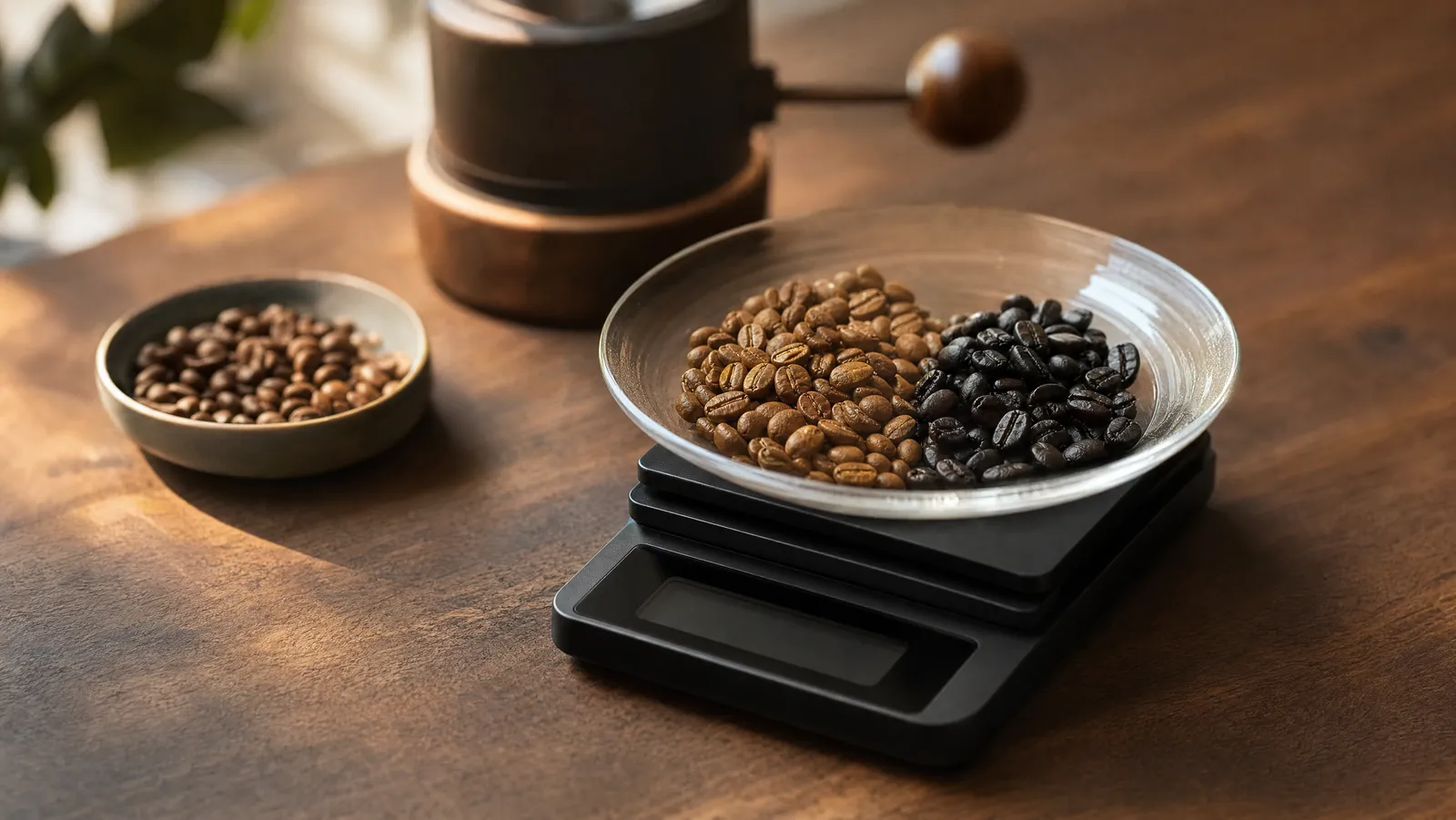
Affiliate disclosure: Sweeter Grind is a participant in the Amazon Services LLC Associates Program. We may earn commissions on qualifying purchases at no extra cost to you.
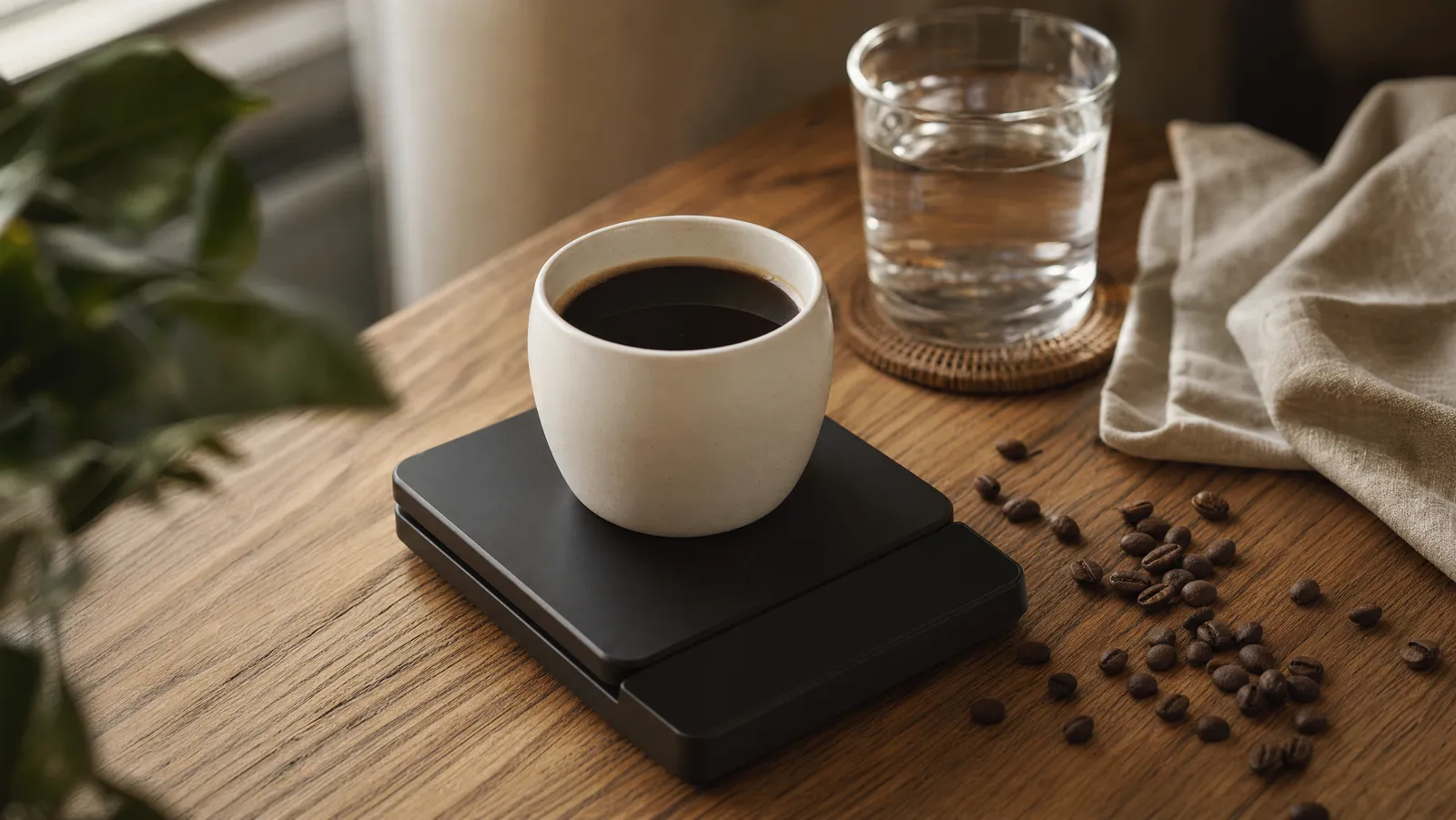
Half caff coffee is a blend of caffeinated and decaffeinated beans, usually half and half by weight. You almost never need to buy it pre-blended. Put 9 g of the beans you already drink and 9 g of a decaf coffee you already like on a kitchen scale, tip both into the grinder, and brew as you normally would. That is the entire technique, and it takes about ten seconds.
A bag labelled half-caff makes two decisions for you: it fixes the ratio at 50/50 forever, and it picks the decaf — usually the cheapest one the roaster could source. Blending it yourself costs nothing extra and lets you choose both halves and move between them. That is why this article recommends no products: the honest answer to "which half-caff should I buy" is "beans you like, plus a decaf you like, in whatever proportion suits you."
How to Make Half-Caff at Home
Weigh the two halves, combine them, grind them together, brew normally. Nothing else in your routine changes.
For a single pour-over at 1:16, that is 9 g of regular beans plus 9 g of decaf into the same hopper, then 290 g of water. For a batch brewer, 30 g and 30 g into a litre. For espresso, 9 g and 9 g in an 18 g basket.
Do it by weight, not by scoops. Decaf beans are genuinely lighter: Aaron Braun, a coffee quality specialist at Swiss Water Decaffeinated Coffee Company, told Perfect Daily Grind that decaffeinated coffee is lighter and less dense because the caffeine compounds have been removed, and that after decaffeination the bean's cell structure has been slightly degraded. Two equal scoops are therefore not two equal doses, and the error runs toward under-dosing the caffeinated half. A cheap scale settles it; if you still brew by eye, see do you need a coffee scale.
What Each Ratio Actually Costs You in Caffeine
Nobody does the arithmetic, so here it is. Two published figures anchor it. The US Food and Drug Administration lists regular brewed non-specialty coffee at 113 to 247 mg of caffeine per 12-fluid-ounce serving — roughly 75 to 165 mg in an 8 oz cup — and lists decaf at 2 to 15 mg per 8-fluid-ounce cup. The Mayo Clinic's caffeine chart gives tighter typical values for the same servings: about 96 mg for 8 oz of brewed coffee and about 2 mg for 8 oz of brewed decaf.
Caffeine tracks the mass fraction of each bean, so the blend maths is multiplication. The table below is our arithmetic on those two sources, per 8 oz cup.
| Blend (regular / decaf) | Typical cup, from Mayo Clinic figures | Plausible range, from FDA figures |
|---|---|---|
| 100 / 0 | ~96 mg | ~75–165 mg |
| 75 / 25 | ~73 mg | ~57–128 mg |
| 50 / 50 | ~49 mg | ~39–90 mg |
| 25 / 75 | ~26 mg | ~20–53 mg |
| 0 / 100 | ~2 mg | ~2–15 mg |
Look at what those ranges do to each other. The FDA-derived range for 75/25 (57–128 mg) overlaps almost entirely with the range for 50/50 (39–90 mg). Brew strength, dose and method move your caffeine more than fine-tuning the ratio does. A strong 50/50 cup can out-caffeinate a weak 75/25 one. So do not agonise over 60/40 versus 55/45. Pick 75/25, 50/50 or 25/75, brew consistently, and judge by how you feel.
Residual caffeine in decaf varies more than the averages suggest; for the measured spread rather than the label figure, see our companion piece on does decaf coffee have caffeine. To run these numbers against the rest of your day, our caffeine calculator beats a spreadsheet.
For context, not as a target: the FDA has cited 400 mg a day — about two to three 12-ounce cups of coffee — as an amount not generally associated with negative effects for most adults. The FDA also notes wide variation in how sensitive people are to caffeine and how fast they clear it, and advises anyone pregnant, breastfeeding, or concerned about a condition or medication to talk to their health care provider. Those are doctor questions, not blog questions.
Grind Together or Separately?
Grind them together, at one setting. But the trade-off is real, so here it is honestly.
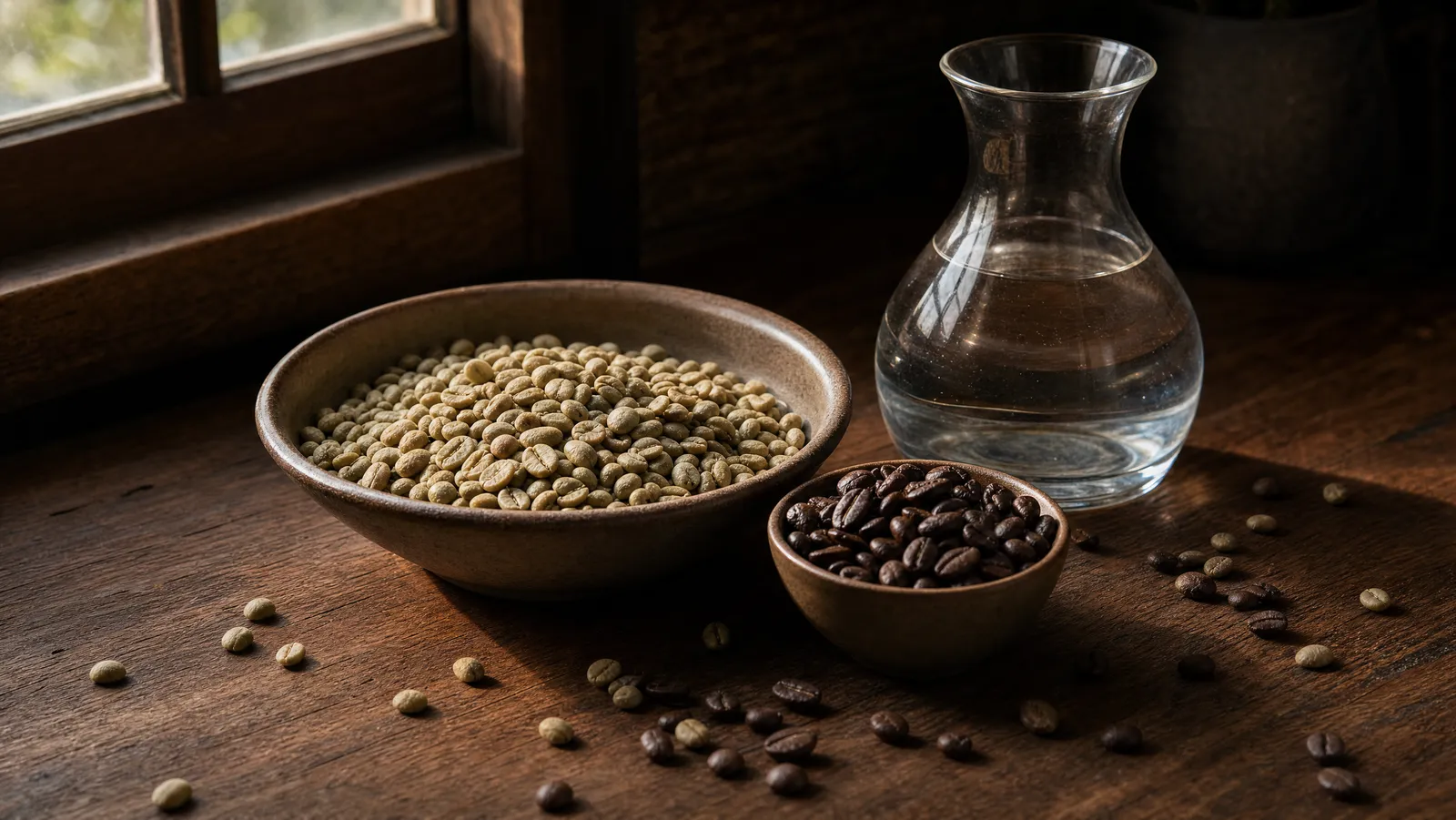
Because decaf beans are less dense and their cell structure is slightly degraded, they tend to be more brittle than the same coffee with its caffeine intact, as roasters widely report. Barista Hustle's work on grind size distribution shows the mechanism: brittle beans shatter into more fines as they pass through the burrs, while beans that are warmer and more plastic break into fewer pieces. A combined grind is therefore a genuine compromise: the blend lands between what each bean would give alone, with slightly more fines than the regular coffee.
In filter coffee that is effectively invisible; the extra fines might add a few seconds to a drawdown. In espresso it is noticeable, because fines build puck resistance. Grinding the halves separately at their own settings is more work for a benefit we would not expect most people to taste in a drip cup. If the decaf half tastes thin, the fix is usually a brewing one — see why decaf tastes different and how to brew it.
Why People Go Half-Caff
Three different readers arrive here, and the advice differs for each.
The taper
If the goal is four cups down to one, half-caff is the most useful tool available, because it cuts the dose without cutting the cup. Same number of mugs, same times of day, same habit — you shift the blend. Moving from 100/0 to 75/25 removes roughly a quarter of the caffeine while changing nothing you can perceive.
The noon switch
The most common pattern, and the one we would try first, is not a blend at all: full-strength coffee in the morning, then switch beans at midday to half-caff or straight decaf. Normal morning, calm afternoon. The reason it works is the half-life problem below.
The evening cup
If what you miss is coffee after dinner, go mostly decaf, or straight decaf. A 25/75 blend lands near 26 mg in a typical cup on the Mayo Clinic figures — about a quarter of a normal coffee — enough to keep the flavour of a blend you like without treating bedtime as optional.
One thing half-caff is not: a health intervention. Cutting the caffeine does not make coffee "lighter" in any other sense. It does not change acidity, calories or anything else in the cup. This is a scheduling decision, not a wellness one. And if the worry running underneath is the decaf half itself, we went through the observational research and the solvent question in whether decaf coffee is bad for you.
Caffeine Withdrawal, Briefly and Honestly
Caffeine withdrawal is a recognised clinical entity, and the timeline is documented. The StatPearls review of caffeine withdrawal, published on the NIH's NCBI Bookshelf, reports that symptoms typically begin 12 to 24 hours after cessation, peak between 20 and 51 hours, and may persist for 2 to 9 days. The listed symptoms are headache, fatigue or drowsiness, decreased alertness, depressed or irritable mood, difficulty concentrating, and flu-like symptoms. That symptom set was established by the critical review Laura Juliano and Roland Griffiths published in Psychopharmacology in 2004, which most later guidance leans on.
The approach in that literature is gradual rather than abrupt. StatPearls states that gradual tapering over several days to weeks is preferred to abrupt cessation, and that reducing intake by 25% to 50% every few days is effective at preventing withdrawal in heavy users. A commonly suggested simpler version is cutting roughly a quarter of the dose per week — which maps neatly onto stepping from 100/0 to 75/25 to 50/50 to 25/75.
We are not prescribing a schedule, and none of this is medical advice. Many people find a slow taper easier; some find the reverse. If caffeine interacts with a medication you take, or you are pregnant, that conversation belongs with your doctor.
The Half-Life Problem
Here is the figure that explains the afternoon cup. According to the StatPearls review, the mean half-life of caffeine is approximately 5 hours, ranging from 1.5 to 9.5 hours, depending on factors including pregnancy, obesity, oral contraceptive use, smoking and altitude.
Run it forward. A 96 mg coffee at 3pm, on a 5-hour half-life, still leaves something like 48 mg at 8pm and roughly 24 mg at 1am — a quarter of the original dose, arriving at the worst possible moment. On a 9.5-hour half-life, more than half of it is there at bedtime.
The width of that range is the important part. A 1.5-hour clearance and a 9.5-hour clearance are not the same person's problem. Fast metabolisers may pay nothing for a late coffee; for slow ones, an afternoon cup is a sleep decision dressed up as a drink. The FDA itself notes the wide individual variation in elimination rate. Half-caff gives you a dial rather than a switch.
Half-Caff Espresso
Espresso is where blending gets fiddly, and we would rather say so.
A blend of two beans with different densities dials in differently from either alone. Because the decaf half contributes more fines, a half-caff basket tends to run tighter and slower at the same setting, which usually means going a step coarser. The Mayo Clinic chart puts a 1 oz espresso at about 64 mg of caffeine, so a 50/50 double lands near half that per ounce.
There is no clever fix. Pick one ratio and stay on it — every time you change the proportion you are, as far as the grinder is concerned, changing coffees. If you want the decaf half to hold up under 9 bars, start with best decaf espresso beans.
Why Not Just Buy Pre-Blended?
Pre-blended half-caff exists and is a reasonable convenience buy. An office kitchen, a guest cupboard, a house where several people share one bag and nobody wants to run a scale: a bag that says half-caff on the front solves a real coordination problem. We are not arguing that blending your own is purer.
The argument is narrower, and it is about two things. Ratio control: a pre-blend is 50/50 and always will be, which is useless if you are tapering in steps or want 25/75 for the evening. Decaf quality: you cannot see which decaf went into the bag, and the decaf half is the half most likely to be dull. Roasters who take decaf seriously sell it as its own product with the origin and process on the label; roasters who do not tend to bury it in a blend.
So the decaf half should be a decaf you would happily drink on its own. If you do not have one, that is the job of our list of the best decaf coffee beans: pick one, pair it with the bag you already buy, and you have a better half-caff than any pre-blend for the same money.
The Ritual Is Most of the Value
Strip the caffeine out of a morning coffee and look at what is left. The grinder noise, and the smell that fills the kitchen in two seconds. Weighing. Waiting for water. The bloom, which is the best-smelling thirty seconds of the day. Ten minutes at the counter doing one thing before anybody needs anything from you.
None of that depends on a stimulant. That is the quiet point of half-caff and of decaf generally: the part of coffee people are attached to is the part caffeine has nothing to do with. Which makes the ritual portable. Move it to 8pm and it is the same ritual — same beans, same kettle, same ten minutes — dialled down.
The dial has more positions than most people use. Start at 50/50, move it when you want, and let the arithmetic above tell you where you landed. For the wider picture — how decaffeination works, what to read on a decaf label, how to brew it well — read Sweeter Grind's complete decaf coffee guide.
Frequently Asked Questions
How much caffeine is in half-caff coffee?
Roughly half a normal cup. On the Mayo Clinic's figures — about 96 mg for 8 oz of brewed coffee, about 2 mg for 8 oz of decaf — a 50/50 blend works out near 49 mg. The honest answer is a range: on the FDA's published 113–247 mg per 12 oz regular cup and 2–15 mg per 8 oz decaf cup, 50/50 lands between about 39 and 90 mg per 8 oz.
Is half-caff better than quitting caffeine cold turkey?
For most people it is easier. The StatPearls review of caffeine withdrawal on the NIH's NCBI Bookshelf states that gradual tapering over several days to weeks is preferred to abrupt cessation, and that cutting intake by 25% to 50% every few days is effective at preventing withdrawal in heavy users. Half-caff executes that taper without giving up the cup. Whether to stop at all is a question for you and your doctor.
Can you make half-caff with instant coffee or pods?
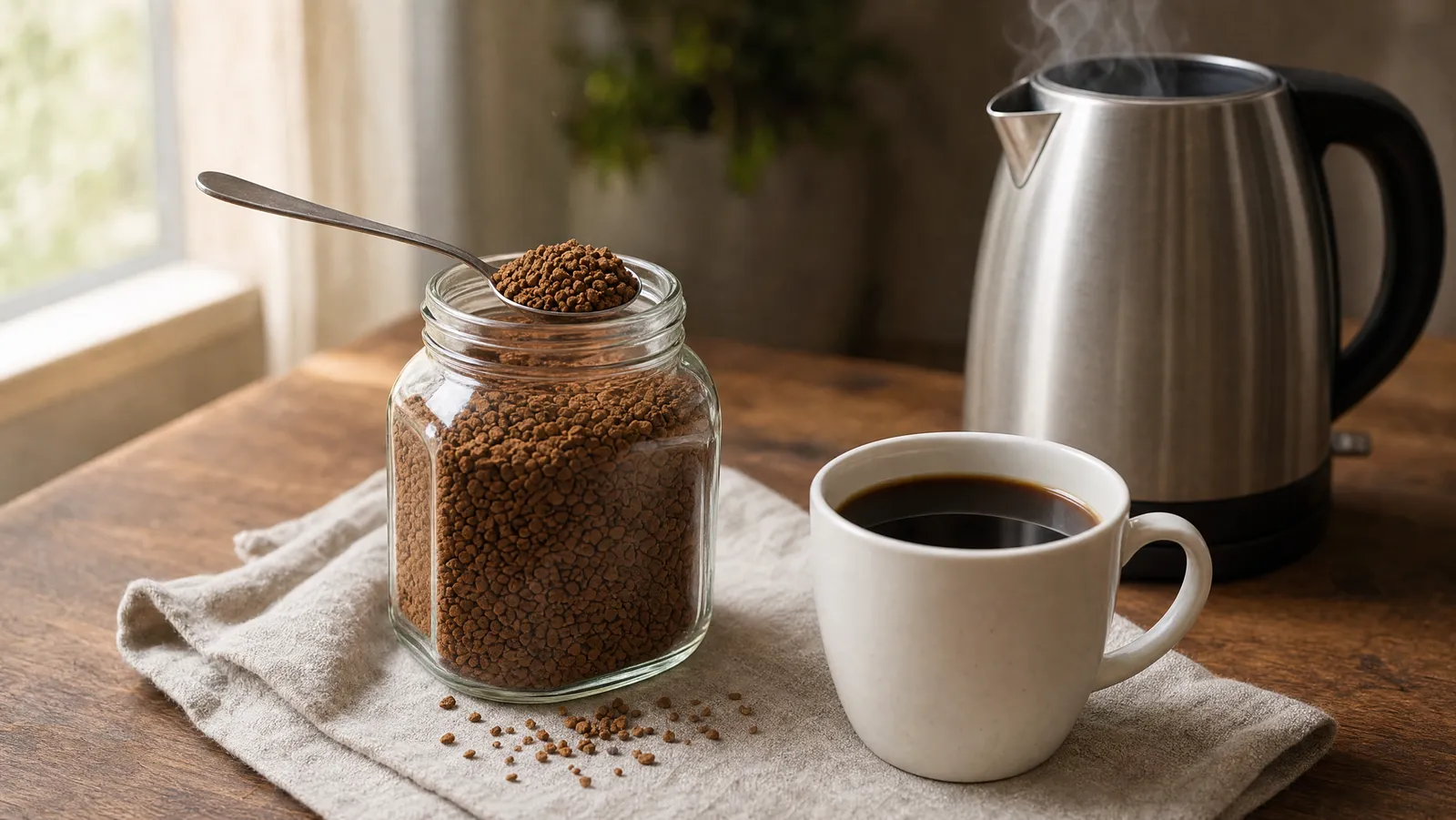
With instant, easily: half a spoon of regular and half a spoon of decaf in the same mug, and because instant dissolves completely there is no grind compromise. Pods are harder, because a sealed capsule is a fixed dose you cannot split. Your options there are alternating regular and decaf pods through the day, or buying pre-blended half-caff pods if your system sells them.
Does half-caff taste different from regular coffee?
Slightly, and it depends on the decaf you chose rather than on the blending. A good decaf at 50/50 tastes like a mild version of the beans you like; a poor decaf drags the cup toward flat and woody. There is also a small textural effect, since decaf beans tend to be more brittle and, as Barista Hustle's work on grind size distribution explains, brittle beans produce more fines — which shows up as slower drawdown and a touch more body. We would not expect most drinkers to notice it in filter coffee.
Is half-caff worth it if you are only cutting one cup a day?
If that cup is the afternoon one, yes, and the reason is pharmacokinetics rather than quantity. The StatPearls review puts the mean half-life of caffeine at approximately 5 hours, with an individual range of 1.5 to 9.5 hours, so one mid-afternoon coffee can still be measurably present at bedtime for a slow metaboliser. Swapping that cup changes your daily total modestly and your bloodstream at 11pm considerably. If the cup you want to cut is the 7am one, the case is weaker — you may simply prefer a smaller dose.
Should I grind the regular and decaf beans separately?
Not for filter coffee — the difference is invisible in a drip or pour-over cup. For espresso it is more defensible, because fines drive puck resistance and the decaf half contributes more of them. Even there, we would rather you dialled one fixed ratio in as a single coffee than added two grinding steps to every shot.