How to Clean a Burr Grinder (Without Wrecking the Burrs)
 Tommie Chaney·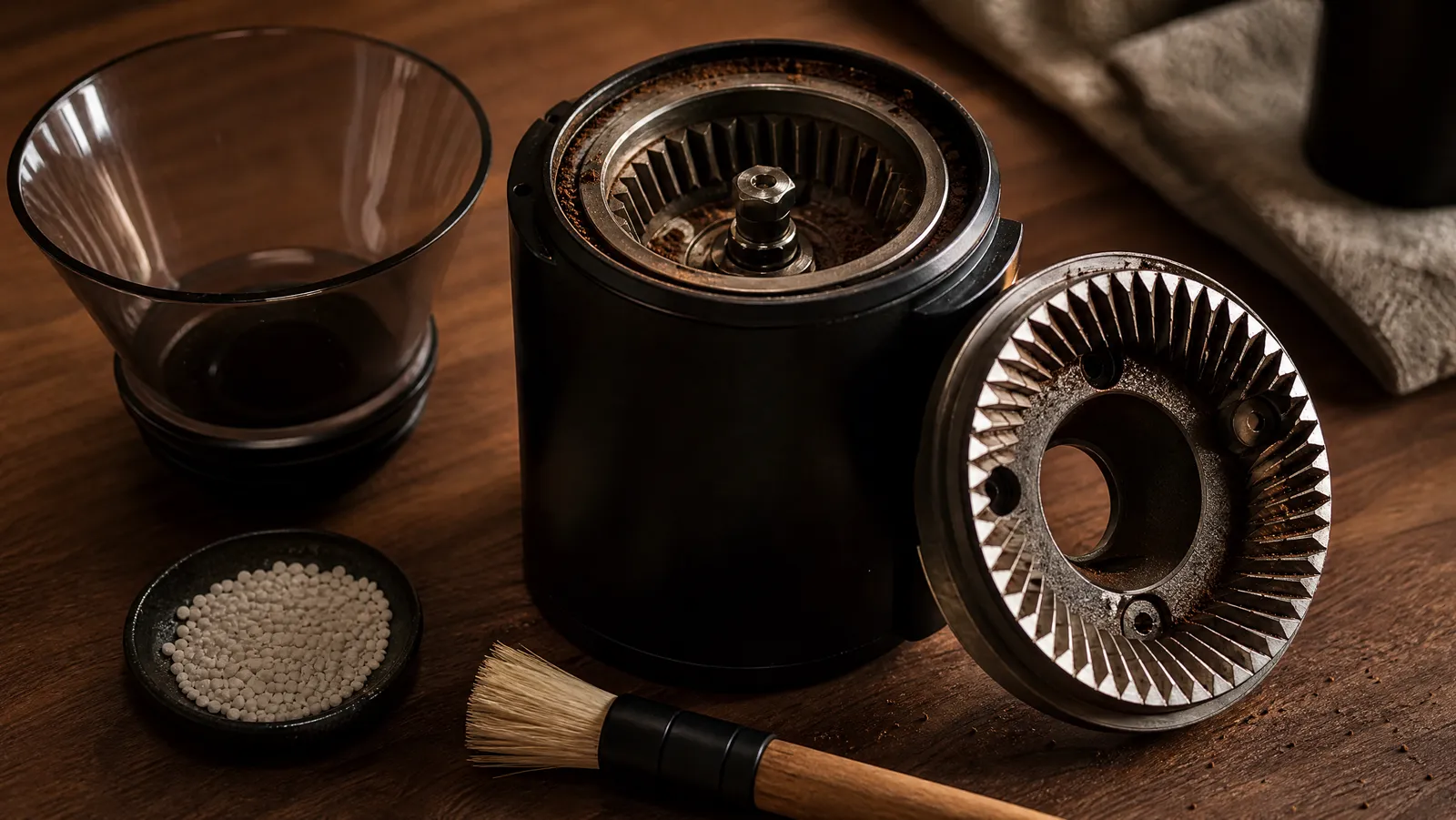
Affiliate disclosure: Sweeter Grind is a participant in the Amazon Services LLC Associates Program. We may earn commissions on qualifying purchases at no extra cost to you.
Cleaning a burr grinder is three jobs, not one: brush and vacuum the grind chamber, run cleaning tablets through the burrs to lift the oils, and pull the burrs for a dry deep clean on a schedule. One rule governs all of it — keep water away from steel burrs.
That last rule is where most guides quit. They say "clean it regularly" and move on, which is how people end up rinsing burrs in the sink or dumping rice into an expensive burr grinder. Here's the specific version: what to do, how often, what the tablets contain, and which habits cause real damage.
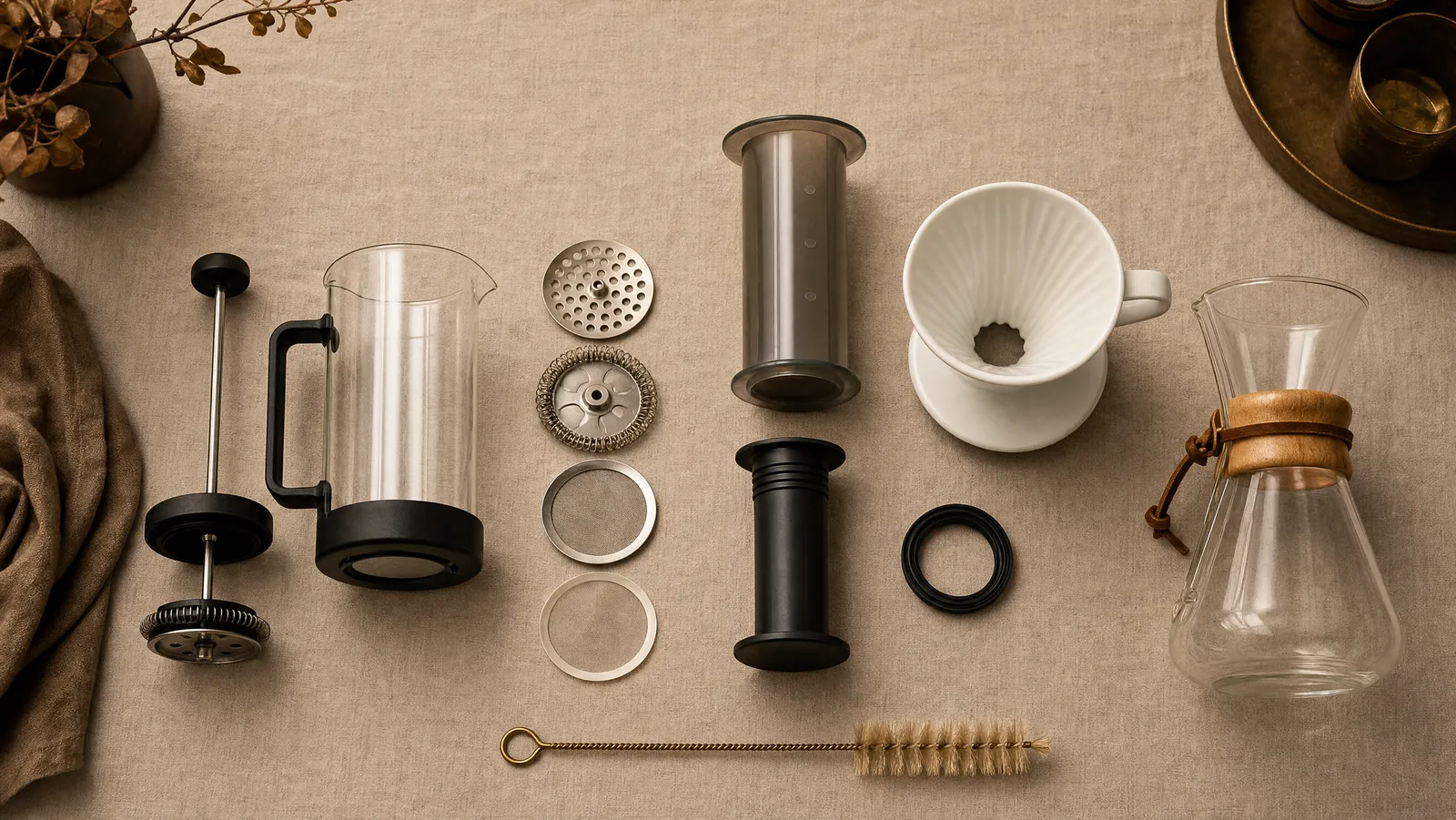
This article covers the grinder only. For the rest of the kit, see our guide to cleaning and descaling every piece of coffee gear.
Why Grinders Get Dirty Faster Than You Think
Grinding smears coffee oil onto every surface the grounds touch: burr faces, carrier, chamber walls, chute, bin. According to the Specialty Coffee Association's literature review on coffee staling, oxygen is the leading driver of staling in roasted coffee, and grinding accelerates it by raising the surface-to-volume ratio of the coffee. The residue inside your grinder is the worst case of that equation — maximum surface area, permanent air exposure, and it never gets thrown out. Research on coffee lipids attributes the resulting papery, stale and rancid notes to oxidation of unsaturated lipids. The problem that governs how you store coffee beans for freshness runs continuously inside the machine.
Roast level sets the pace. Baratza's cleaning guidance notes that dark roasts "need cleaning more often due to the oils they leave in the grinder" — in practice a dark-roast grinder tends to look visibly oily inside within a bag or two, while a light-roast grinder stays dusty.
The second problem is retention: grounds that go in and don't come out. A US patent filing for a reduced-retention grinder design describes conventional grinders as holding roughly 5 to 15 grams of ground coffee between extractions. Even well below that figure, the first grams of today's dose are yesterday's — oxidized, pressed against oily burrs.
How Often to Clean a Burr Grinder
Frequency is a function of volume and roast level, not the calendar.
| Your routine | Quick brush-out | Tablets or pellets | Deep clean (burrs out) |
|---|---|---|---|
| A bag every 2–3 weeks, light to medium roast | Monthly | Every other bag | Every 3 months |
| A bag a week, light to medium roast | Every 2 weeks | Every 4–6 weeks | Every 4–6 weeks |
| Espresso daily, or any dark/oily roast | Weekly | Every 2–4 weeks | Monthly |
| Flavored or oil-coated beans | After every use | After every bag | Monthly |
Manufacturers publish surprisingly different intervals. Baratza's grinder-cleaning guidance sets routine cleaning at every 4–6 weeks. Fellow's support documentation for the Ode Brew Grinder Gen 2 says that with daily use, the burrs should be cleaned at least every three months. 1Zpresso's FAQ tells hand-grinder owners to disassemble and clean thoroughly once a month. America's Test Kitchen, citing Coffee Project New York co-founder Kaleena Teoh and Joe Coffee's Cara Mitchell, recommends at least monthly, more for oilier beans.
What You'll Need
- A stiff nylon or boar-bristle brush — the one that shipped with your grinder is fine; a soft pastry brush is not.
- A vacuum with a crevice or hose attachment. Prima Coffee's guide recommends the hose attachment to "suck out all the remaining bits and debris" once the burrs are exposed.
- A dry microfiber cloth for the chamber walls. Dry, not damp.
- Grinder cleaning tablets or pellets — Urnex Grindz and Urnex Biocaf (the line Urnex previously sold as Full Circle) are what the specialty trade uses.
- A screwdriver or hex set matched to your model, only if your grinder needs tools to open.
- Optional: a bulb-style air blower, which 1Zpresso pairs with a dry brush in its own cleaning guidance.
- Optional: a paperclip. Baratza suggests "the handle of your cleaning brush, or a small, stiff item like an unfolded paperclip" for a blocked chute.
We cover brands and formats separately in a companion piece on the cleaning supplies you actually need. If you're still building a setup, our ultimate coffee equipment guide covers what to buy in what order.
How to Clean a Burr Grinder, Step by Step
Read your manufacturer's manual before you open anything. Disassembly depth varies enormously, and on some grinders removing the lower burr is a calibration job, not cleaning.
Step 1: Unplug the grinder and empty the hopper
Pull the plug from the wall — not off, not standby. A grinder that starts while your fingers are in the burr chamber is the one genuinely dangerous failure mode.
Empty the hopper, then run the grinder for 10–20 seconds to clear the throat. Fellow's Ode Gen 2 documentation calls for exactly this before tablet cleaning.
Step 2: Run cleaning tablets or pellets through
Tablets are the no-disassembly option, and the only cleaning consumable most manufacturers endorse. According to Urnex, Grindz is "formulated from all natural, plant-based ingredients," contains no phosphates, and "removes coffee oils and grind particles from burrs and casings without disassembling the grinder." Urnex directs users to 35–40 g (one jar cap) for espresso grinders, or 70–80 g for shop grinders.
Set a medium-to-coarse grind and run the full dose. Fellow's guidance for the Ode Gen 2 is specific: grind the tablets at setting 11, then run approximately 30 g of coffee through to flush out residue.
Step 3: Remove the hopper — and record your grind setting first
Photograph the dial before you touch anything. This is the most common regret in grinder cleaning: the machine goes back together fine, and then every shot chokes.
On a Baratza Encore, the documented sequence is to rotate the hopper counter-clockwise until the grind indicator passes 40, lift it off, and peel away the silicone gasket.
Step 4: Lift out the upper burr
On most conical home grinders the upper burr sits in a plastic carrier that lifts straight out. The Baratza Encore manual's instruction is to remove the ring burr "by lifting it straight up out of the grinder by the lifting tabs," and adds that if the burr does not lift out, you should check that the grind adjustment ring is turned fully counter-clockwise.
Don't force it. If a carrier resists, stop and re-check that adjustment ring — levering is how carriers crack.
Step 5: Brush and vacuum the burr chamber
Brush downward and outward, clearing packed fines from the gap between the lower burr and the housing — that gap holds the oiliest material in the machine. Then vacuum with the crevice tool, so you remove debris rather than relocate it into the chute. Run the cycle twice.
Step 6: Clean the burrs dry
This is the step that ruins grinders. According to Baratza's Encore cleaning documentation, you should use the provided brush to clear the burr of grounds and residue, and "do not wash with water, this will cause rusting and corrosion." Prima Coffee's guide says the same: avoid moisture near the burrs and grind chamber.
So — stiff brush, then a dry microfiber cloth on the burr faces and carrier. No sink, no soap, no damp paper towel. Ceramic burrs are the exception to the rule, not an extension of it: they don't rust, and makers of ceramic hand mills say so — Hario describes the Skerton Pro's inner ceramic burr as "easily detached and washed." Steel burrs get no such allowance.
Step 7: Clear the chute and the exit path
The chute is where oily fines bridge into a clog, and almost everyone forgets it. Brush from the burr side toward the exit, then back the other way; Baratza suggests an unfolded paperclip or the brush handle for stubborn blockages. Fellow's routine maintenance for the Ode Gen 2 is essentially this step alone — remove the catch cup and gently sweep the exit chute and the anti-static pins beside it.
Step 8: Reassemble, verify the setting, and purge
Seat the gasket, drop the carrier in, refit the hopper, and return the dial to the number you photographed in Step 3.
Then verify rather than assume. Prima Coffee notes that when you remove and replace an upper burr, "the adjustment settings can get just a touch out of place," and recommends grinding 10–20 grams afterward to reset everything. Check that purge dose against our grind size guide before brewing a real cup, and if it's off by a step, adjust and note the new reference number.
Conical vs Flat Burrs: What Changes
The procedure above assumes a conical grinder — what most home kitchens have. Flat burrs change two things.
Disassembly. On a conical grinder the upper burr is usually a cone-and-ring assembly in a carrier that lifts out by hand. On many flat-burr grinders it's a ring fastened with screws into the chamber, so you need a driver — and removal is more likely to disturb the factory alignment between the two burr planes. If yours is screwed in, deep-clean less often and lean harder on tablets.
Where the mess collects. Conical grinders hold grounds in the vertical throat above the burrs and the chute below. Flat-burr grinders throw grounds outward across a horizontal exit path, so fines pack along the chamber wall and discharge track. That's where your brush should spend its time — and part of why flat burrs are described as retaining more than comparable conicals.
Manual Grinders Are Different
Hand grinders disassemble further than electrics, so you can reach every surface. That also creates more chances to wet something you shouldn't.
1Zpresso's FAQ is blunt: "Do not clean the grinder with water." Their method is a dry brush and an air blower, with a full disassembly and thorough clean once a month. For oil and odor buildup, 1Zpresso suggests grinding rolled or instant oats, then wiping with a towel that is damp — not wet — and drying immediately, warning that "excessive moisture will damage the grinder." For wooden components: brush only, never apply water.
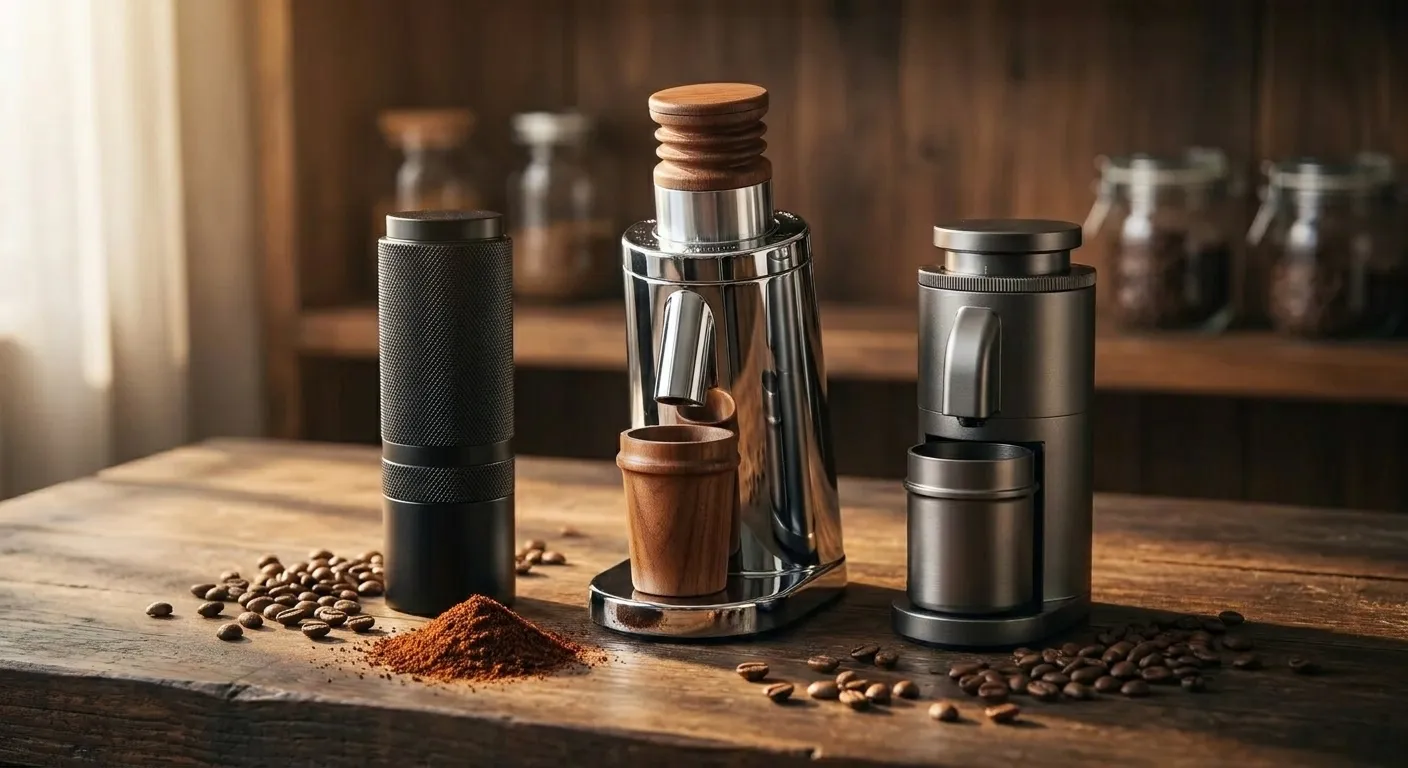
The parts to keep permanently dry are the steel burrs, the shaft bearings, and any wood. Bearings are the underrated one — lubricated, not sealed against detergent, and rinsing one out may wash that lubrication away and leave a gritty crank feel that is hard to recover. Catch cups and plastic lids are usually water-safe; dry them fully before reassembly. Our comparison of manual vs electric coffee grinders goes deeper on the upkeep trade-off.
Mistakes That Actually Damage Grinders
Washing steel burrs. Baratza's documentation states plainly that washing with water causes rusting and corrosion. Rusted burrs get replaced, not rescued.
Losing the grind-setting reference. Not damage, but it costs a week of bad coffee. Photograph the dial first.
Forcing a burr carrier. Carriers are plastic on most home grinders. If it doesn't lift under light pressure, something is still holding it, and prying turns a cleaning session into a parts order.
Rice — and this one is contested. America's Test Kitchen calls the rice trick a viral hack and debunks it, quoting Kaleena Teoh: "You could hurt the burrs, permanently damage the motor, or clog up the grinder with starchy rice." Prima Coffee reports that Baratza does not cover damage caused by the use of rice and recommends Full Circle or Grindz pellets instead, noting rice can be considerably harder than a coffee bean. The counterpoint worth knowing: the underlying idea — grind something absorbent to lift oils — is sound, and 1Zpresso endorses it with oats, which are far softer. The disagreement isn't about the technique. It's about the hardness of the grain.
Machine-washing removable parts. Fellow's Ode cleaning guidance is unambiguous: any part that can be removed from the grinder should never be machine-washed, and no part other than the catch cup and lid should be submerged in water at all. Baratza is equally direct about the Encore's hopper, hopper lid and grounds bin — hand wash in warm soapy water, not in the dishwasher. Dishwasher heat and detergent can cloud, warp and craze hopper plastics.
Blasting canned compressed air into an electric grinder. A squeeze bulb is fine — it's what 1Zpresso recommends. We'd be more careful with high-pressure canned air on an electric machine: the pressure has to go somewhere, and "somewhere" may be the motor housing and bearings.
Frequently Asked Questions
Can I wash burrs with water?
No — not steel burrs. According to Baratza's Encore cleaning documentation, washing the burrs with water will cause rusting and corrosion, and Prima Coffee's guide gives the same warning. Use a stiff dry brush and a dry cloth. Hoppers, grounds bins and rubber collars can generally be washed in warm soapy water and dried thoroughly.
How often should I clean a coffee grinder?
Manufacturers cluster between monthly and quarterly. Baratza sets routine cleaning at every 4–6 weeks; Fellow says the Ode Gen 2's burrs need cleaning at least every three months with daily use; 1Zpresso calls for a monthly full disassembly; America's Test Kitchen's experts recommend at least monthly. Add a weekly brush-out of the chute.
Is it safe to clean a coffee grinder with rice?
Manufacturers say no. Prima Coffee reports that Baratza doesn't cover rice-related damage and points customers to Full Circle or Grindz pellets, and America's Test Kitchen quotes Kaleena Teoh warning that rice can hurt the burrs, damage the motor or clog the grinder with starch. For a pantry option, 1Zpresso suggests rolled or instant oats.
What are grinder cleaning tablets actually made of?
Grain. Urnex describes Grindz as formulated from all natural, plant-based ingredients with no phosphates, and says the tablets remove coffee oils and grind particles from burrs and casings without disassembling the grinder. Urnex's Biocaf tablets — the line formerly sold as Full Circle — are described by Urnex as plant-based, phosphate-free and made from food-safe ingredients, and by retailers as fully biodegradable. No solvent is involved — the pellets are a mildly abrasive, absorbent medium.
Do I need to recalibrate my grinder after cleaning?
Usually not recalibrate, but always re-verify. Prima Coffee notes that removing and replacing an upper burr can shift the adjustment settings slightly, and recommends grinding 10–20 grams afterward to reset things.
Will cleaning my grinder change how the coffee tastes?
Yes, most noticeably on the first few cups. You're removing oxidized oil film that contributes stale and rancid notes, plus retained grounds from previous bags — the effect is largest on dark roasts.
Where This Fits in the Rest of Your Setup
A clean grinder is half the job. It won't rescue a brewer whose water path is furred with scale — a separate procedure with different chemistry, covered in how to descale a coffee maker. Grinder cleaning is dry work; descaling is wet work.
The habit is small: brush the chute weekly, run pellets on the schedule above, open the burrs monthly-to-quarterly. Photograph the dial, keep water off steel, never force a carrier.
For the rest of the machines on your counter, work through the complete coffee equipment cleaning guide.
Related reading
- Burr Grinder vs Blade Grinder — why burr geometry matters first
- Manual vs Electric Coffee Grinder — the upkeep trade-off
- How to Descale a Coffee Maker — the wet half of maintenance
- How to Store Coffee Beans for Freshness — the same oxidation problem, upstream
- The Ultimate Coffee Equipment Guide 2026 — what to buy, in what order