How to Set Up a Home Coffee Syrup Bar (Pumps, Bottles and Storage)
 Tommie Chaney·
Affiliate disclosure: Sweeter Grind is a participant in the Amazon Services LLC Associates Program. We may earn commissions on qualifying purchases at no extra cost to you.
Four pumps of vanilla is not a measurement.
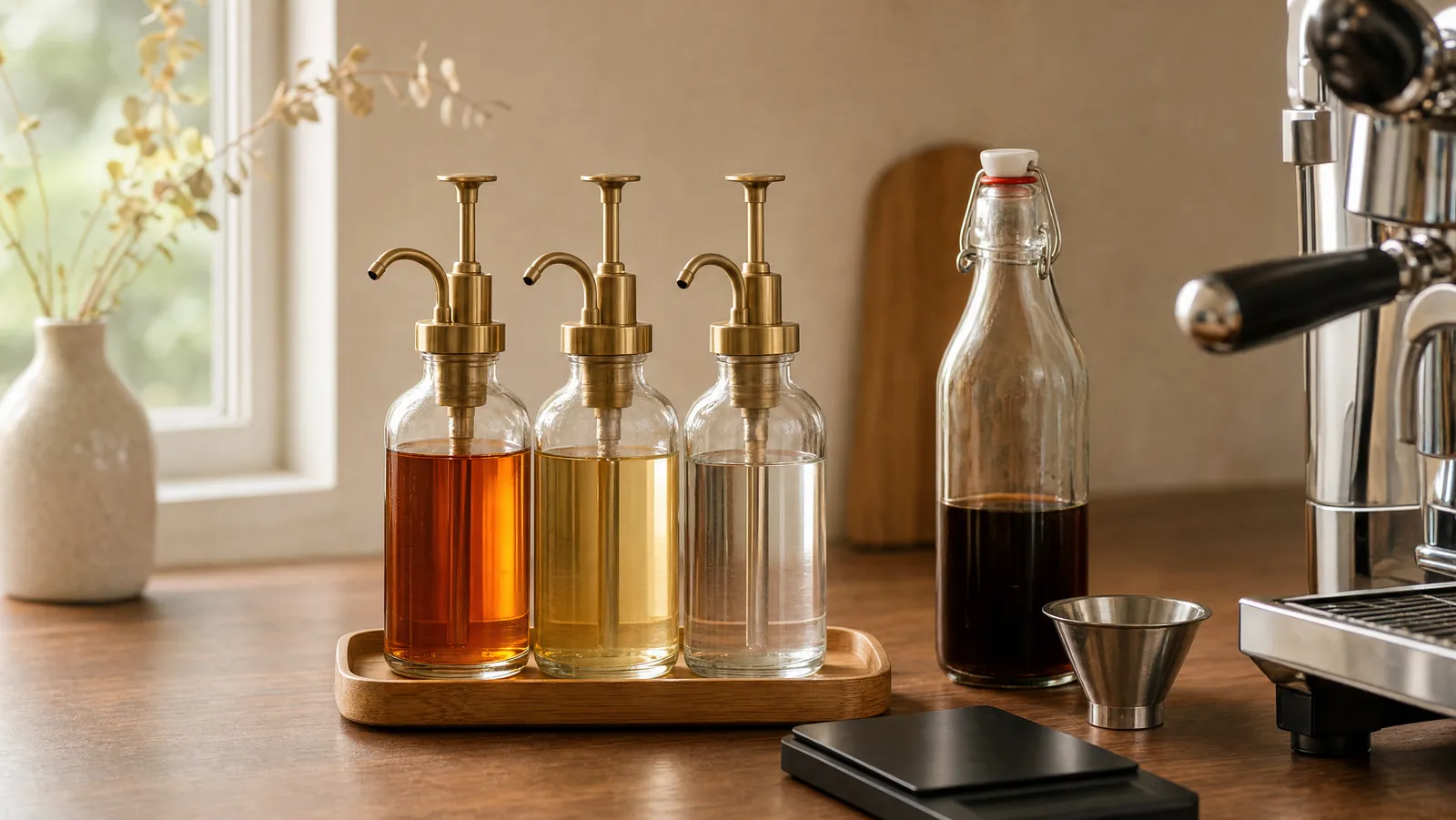
A home coffee syrup bar needs three bottles, not six: two syrups you drink weekly plus one seasonal. Put store-bought syrup in pump dispensers sized to the bottle you actually buy, keep homemade syrup in swing-tops in the fridge, and label every bottle with a date. Hardware runs $30 to $60 at October 2026 prices.
Ten minutes of planning is worth it, because a syrup station is the part of making coffee shop drinks at home that decays quietly. Nobody throws out a syrup bar. It silts up until two bottles are crusted shut and you stop reaching for any of them.
Not every syrup pump dispenses the same amount
This is the number that explains why a drink you copied from a café does not taste the way it did at the café. Pump dose is not standardized, and the gap between common dispensers is wide.
| Dispenser set | Bottle size | Listed dose per press | Presses to empty a bottle |
|---|---|---|---|
| ALPENKOK, set of 4 | 500 ml | 2 ml (about 1/2 tsp) | about 250 |
| New England Stories, set of 4 | 500 ml | 2 ml (1/2 tsp) | about 250 |
| GYOSUGANG, set of 3 | 500 ml | about 2 ml | about 250 |
| Demi's Home, set of 4 | 750 ml | 1/4 oz (about 7.4 ml) | about 100 |
Those are the makers' listed specs, not volumes we measured. ALPENKOK states "precise 2 ml portions per press"; Demi's Home states "1/2 tablespoon (1/4 oz.) in each pump."
A quarter of a US fluid ounce is about 7.4 ml, so the Demi's pump delivers roughly 3.7 times more syrup per press than the 2 ml pumps. A recipe written as "four pumps" means 8 ml on one set and a full fluid ounce on the other. That is the difference between a lightly sweetened latte and a dessert.
Cafés sit at the 1/4 oz end of that range. Monin lists its own 750 ml glass-bottle pump at 1/4 oz per press, which is the standard foodservice portion. So the error runs both ways: copy a café's pump count onto a 2 ml home pump and the drink comes out thin, and run a recipe written for a 2 ml pump through a 1/4 oz pump and it comes out cloying.
Write your recipes in milliliters once, then convert to presses for the pump you own.
How to set up a home coffee syrup bar, step by step
Step 1: Decide the rotation before you buy anything
Two permanent syrups plus one seasonal. Three bottles. Vanilla and caramel are the usual pair because they go in almost everything, and the third slot rotates: peppermint or gingerbread in December, brown sugar the rest of the year. We have compared which syrup brand to put in them separately, along with the best sugar-free coffee syrups if that is what your rotation runs on, and that rotating slot is where holiday coffee drinks at home earns its keep. Four bottles is defensible if two people drink different things. Six is not: the extra bottles sit untouched long enough to go sticky, and a sticky pump is a pump you replace.
Step 2: Match the bottle size to the syrup you actually buy
Retail syrup bottles are usually 750 ml: that is Torani's and DaVinci's standard size and Monin's glass format, though Monin also sells a 1 litre plastic bottle that overflows every dispenser here. Most dispenser sets are 500 ml. Pour one into the other and 250 ml goes back in the cupboard, which is the clutter the dispenser was supposed to remove.
Pick one way out rather than hedging. Either buy 750 ml dispensers so a retail bottle empties cleanly, or accept topping up a 500 ml bottle mid-week. Per milliliter of capacity they cost nearly the same, about 1.2 cents for the ALPENKOK four-pack against 1.3 cents for the Demi's as of October 2026. You are choosing a workflow, not a price. Buy syrup by the 750 ml bottle and you want the 750 ml dispensers. Otherwise stay at 500 ml.
Step 3: Measure the gap under your wall cabinets
Do this with a tape measure before you order. According to House Digest, the standard gap between the countertop and the bottom of the upper cabinets is 18 inches, and Bob Vila builds the same figure from a 34.5 inch base cabinet, a 1.5 inch countertop and an 18 inch backsplash, putting the underside about 54 inches off the floor. Kitchens do run lower: House Digest gives a workable range of 15 to 20 inches and calls 15 inches the practical floor, and Bob Vila's accessible layout drops the clearance to 14 inches.
Hold the specs against that. ALPENKOK lists 8.7 inch bottles, leaving about nine inches of working room. Demi's lists 14.6 inches with the pump unlocked, which leaves 3.4 inches under an 18 inch gap, about four tenths of an inch at the 15 inch low end, and nothing at all in a 14 inch accessible kitchen. It will stand there, but you will not lift it out to refill without walking it forward. The 750 ml set wants open counter or a shelf. The 500 ml sets live under cabinets.
Step 4: Keep pump bottles for store-bought syrup and swing-tops for homemade
Two different storage problems, and one bottle cannot do both.
Commercial syrup is built for room temperature. Monin's help center puts an opened bottle at 90 to 180 days with the cap on, dropping to 30 to 60 days once a pump or pour spout is fitted, stored between 65 and 80 degrees Fahrenheit somewhere dry and clean. That is a counter product.
Homemade syrup is a fridge product with a real expiry. Sugar helps by lowering water activity, but only so far: Virginia Tech Extension explains that the FDA recognizes foods at or below 0.85 water activity as water activity-controlled, where pathogenic bacteria cannot grow, and adds that some yeasts and molds may still grow below that line. That is why forgotten homemade syrup goes fuzzy, and why a counter pump bottle is the wrong home for it. Anything you brew from DIY coffee syrup recipes belongs in a swing-top in the refrigerator.
Step 5: Label with the date and the ratio, not the flavor
You can see that it is brown. You cannot see that it was made on the 2nd, or that it was a 2:1 rich syrup rather than a 1:1.
Ratio changes both sweetness per milliliter and how long the bottle keeps. Drinks writer Camper English's informal refrigerator test at Alcademics, which used visible cloudiness as its cutoff, had a 1:1 syrup go off at one month while the 2:1 held for six; recipe sources commonly quote three to four weeks for refrigerated 1:1. Neither is a controlled microbial study, so treat them as planning numbers, and see our simple syrup guide for why the extra sugar buys that time. Write "VAN 2:1 - 10/02" on the label and you never have to taste a mystery bottle again.
Step 6: Build the cleaning routine in before the first refill
Sugar syrup in a pump mechanism is where syrup bars die. It wicks up the shaft, dries, and cements the spring.
Know which routine you are running. Monin tells customers not to wash its own pumps at all, warning that detergent or water residue can contaminate the syrup and that flavors transfer when a pump moves between bottles; its advice is one pump per flavor, capped overnight to keep mold out. That works for a pump living in a disposable retail bottle.
A refillable dispenser is the other case. It moves between flavors, so it has to be washed: pump hot water through until it runs clear, take apart what comes apart, and dry completely before refilling. Do it the day you empty the bottle. For fridge bottles, a removable swing-top assembly matters more for syrup than for water, because dried sugar sets hard in the gasket groove. YEBODA lists a removable assembly; Otis Classic ships six spare gaskets, and gaskets fail first.
Step 7: Put the whole thing on one tray
A tray defines the footprint, so the station cannot creep into the toaster, and it catches the drip ring under every nozzle. Lift, wipe, replace. GYOSUGANG is the only pick here that includes one, and any bamboo or stainless tray does the job.
Sauces need squeeze bottles, not pumps
Caramel and chocolate sauce are a different product, and these pumps are not built for them. Suppliers sell sauce pumps as a distinct variant rather than a separate category: WebstaurantStore files them under syrup pumps and notes that some of its sauce pumps have a removable tip that makes it simple to dispense chunkier and thicker sauces and purees. Amoretti, which sells a dedicated pump for its thicker syrups, warns that a regular pump may struggle with them, leading to clogging or inconsistent portions. Supplier guidance also notes that thick product yields less per press than thin, and that cold product flows worse still. In our experience a 2 ml pump on a real caramel sauce either dribbles or stalls, which is why cafés keep squeeze bottles for sauce. None of the sets below solves that. Leave the sauce in the bottle it came in, next to the tray.
What a working syrup bar costs
Both tiers use prices as of October 2026.
Minimal, three bottles, under $30. The GYOSUGANG set of 3 at $28.89 is the station in one box: three 500 ml bottles with pumps, a funnel, a scoop, 18 labels and the bamboo tray. The trade-off is BPA-free plastic pumps rather than the steel spring ALPENKOK specifies.
Counter plus fridge, about $50. The ALPENKOK four-pack at $24.95 and the Otis Classic swing-tops at $24.99 come to $49.94: four low-profile dispensers for store-bought syrup and six 16 oz fridge bottles for homemade. Swap in the Demi's set and the YEBODA bottles and the same pairing runs $61.79.
Syrup is on top. The hardware is a one-time cost.
What to skip
- A six-bottle wall of flavors. Three get used. The rest go sticky, and a stuck pump usually takes the bottle with it.
- A pump dispenser for syrup you make weekly. Homemade syrup is a fridge product. Swing-tops cost less per bottle and keep the cold chain intact.
- Pressure ratings on swing-tops. Otis Classic lists 4 bar / 58 psi. That is a fermentation spec for kombucha and soda, irrelevant to syrup, and no reason to choose a bottle.
- Paying extra for hardware color. Gold pumps and black pumps dispense identically.
The six picks, and who each one is for
ALPENKOK glass dispenser, set of 4 (500 ml): best pump bottle set
The default. Four 500 ml bottles, a listed 2 ml per press, 18 waterproof labels, and a listed 8.7 inches of height, so four line up under a wall cabinet. ALPENKOK is the only maker here specifying 304 stainless steel pump springs, and the spring is what seizes on cheap pumps. $24.95 as of October 2026.
Demi's Home glass dispenser, 4 pack (750 ml): best for full 750 ml bottles
For people who buy 750 ml bottles and have vertical space. One retail bottle goes in, nothing goes back in the cupboard, and the 59-label set includes sugar-free markings. Both cautions are in the specs: the 1/4 oz dose means café pump counts do not transfer, and 14.6 inches unlocked rules out most under-cabinet spots. $39.95 as of October 2026.
New England Stories dispenser set, 4 bottles (500 ml): best set with a funnel
The same 500 ml layout and listed 2 ml dose as the ALPENKOK set, with gold hardware and a funnel in the box, at $24.99 as of October 2026 against a $29.99 list. The funnel is the reason to prefer it: decanting into a narrow neck without one means wiping the counter every refill.
GYOSUGANG set of 3 with bamboo tray: best small station
The only three-bottle set here, which is the right count, and the only one with a tray. Funnel and scoop included. GYOSUGANG lists BPA-free, food-safe plastic and food-grade PVC pumps at about 2 ml per press. At $28.89 as of October 2026 you pay more per bottle than a four-pack and get the organizing hardware back.
YEBODA 16 oz swing-top bottles, 6 pack: best for homemade syrup storage
The fridge half of the station. Six bottles at $21.84 as of October 2026 works out near $3.64 each, enough for a batch rotation with spares in the dishwasher. YEBODA lists a stainless steel wire closure, a thick silicone gasket, and a removable swing-top assembly, which is the syrup-specific spec.
Otis Classic swing-top bottles, set of 6: best swing-tops with labelling
The same 16 oz six-pack at $24.99 as of October 2026, with a marker, labels and six spare gaskets included, plus the straight sides and tall slim body Otis Classic says make them easier to clean. The gaskets are the long-term value: they perish long before the glass does.
Frequently Asked Questions
How many pumps of syrup should go in a latte?
Ask how many milliliters instead, because a pump is not a fixed unit. For a 12 oz latte we start near 15 ml of 1:1 syrup: seven or eight presses on a 2 ml pump, two on Demi's 1/4 oz pump. Measure it once, count the presses, and that is your number for that bottle.
Do store-bought coffee syrups need to be refrigerated?
Usually not. Monin's help center gives 90 to 180 days for an opened bottle with the cap on and 30 to 60 days once a pump is fitted, stored at 65 to 80 degrees Fahrenheit. Dairy- and cream-based flavors may be the exception, and retailer listings for them disagree, so read the label. Decanting does not extend the syrup's life, so date the dispenser when you fill it.
Can I put homemade syrup in a counter pump bottle?
For a day, yes. As a storage plan, no. Homemade syrup has no preservatives, and water activity explains the limit: per Virginia Tech Extension, foods at or below 0.85 water activity are water activity-controlled under the FDA's threshold, so pathogenic bacteria cannot grow, but some yeasts and molds may. Keep the batch in a swing-top in the fridge and refill a small dispenser from it.
How do you clean a syrup pump that has gone sticky?
Pump hot water through it until it runs clear, then take apart whatever comes apart and dry it completely. Dried sugar dissolves in hot water, so time is the main ingredient. Note that Monin advises against washing its own pumps at all, citing residue and flavor transfer. A refillable dispenser moves between flavors, so it has to be washed; the answer there is drying thoroughly, not skipping the wash.
How many syrup bottles do I actually need?
Three: two flavors you reach for weekly and one seasonal slot you reassign twice a year. A fourth makes sense in a household with split tastes. Past that you are buying storage for syrup that will expire before you finish it.
What we would buy tonight
For most kitchens the GYOSUGANG three-bottle set with the tray is the whole answer in one purchase, and it enforces the rotation that keeps a syrup bar alive. If you also make syrup, pair the ALPENKOK four-pack with the Otis Classic swing-tops for about $50 as of October 2026 and you have covered counter and fridge. Go to the Demi's 750 ml set only if you buy full-size bottles and have room for a 14.6 inch dispenser.
Then do the one thing that makes the rest work: measure 15 ml into your usual cup, count the presses, write it on the label. Once your station speaks in milliliters, every recipe in Sweeter Grind's café drinks guide transfers to your kitchen without a guess.
Related reading
- How to Make Simple Syrup for Coffee
- DIY Coffee Syrup Recipes
- The Ultimate Coffee Equipment Guide 2026
- Brew Ratio Calculator

ALPENKOK Glass Coffee Syrup Dispenser with Pump, Set of 4 (16.9 oz / 500 ml, Black)
Four 500 ml bottles at a listed 8.7 inches tall, so they clear a standard wall cabinet. ALPENKOK lists a 2 ml dose per press and 304 stainless steel pump springs.

Demi's Home Glass Coffee Syrup Dispenser, 4 Pack (25.4 oz / 750 ml)
The only set here that swallows a whole 750 ml retail bottle with nothing left over. Demi's lists a 1/4 oz dose per press and 14.6 inches of height with the pump unlocked.

New England Stories Coffee Syrup Dispenser Set, 4 Glass Bottles with Gold Pumps (16.9 oz / 500 ml)
Same 500 ml bottles and the same listed 2 ml dose as the ALPENKOK set, with a funnel and 28 labels in the box. The gold hardware is a looks decision, not a performance one.
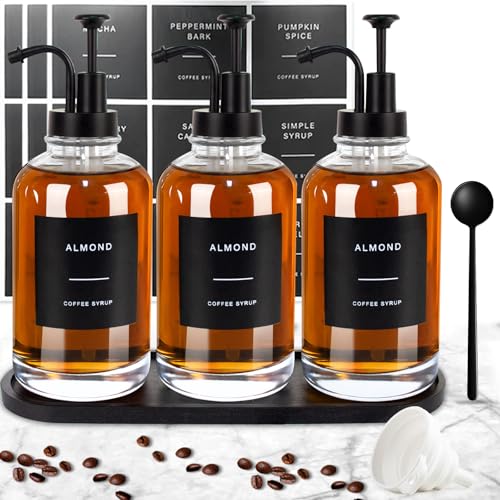
GYOSUGANG Coffee Syrup Dispenser Set of 3 with Bamboo Tray, Funnel and Scoop (16.9 oz / 500 ml)
Three bottles instead of four, plus the bamboo tray that stops a syrup bar sprawling across the counter. GYOSUGANG lists BPA-free plastic pumps rather than a steel spring.
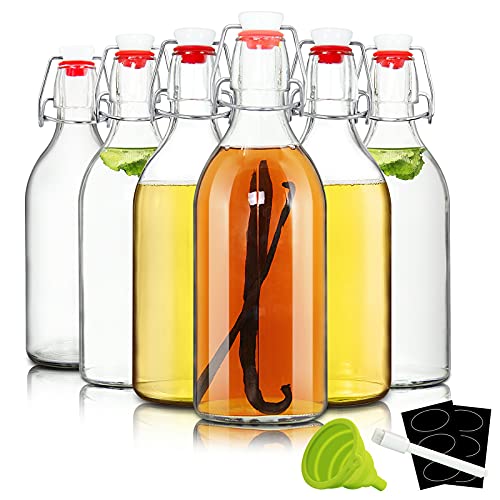
YEBODA 16 oz Clear Swing Top Glass Bottles, 6 Pack
Six 16 oz swing-tops for homemade syrup in the fridge. YEBODA lists a removable swing-top assembly, which is how dried sugar comes back out of a gasket.

Otis Classic Clear Swing Top Glass Bottles, Set of 6 (16 oz, Marker and Labels Included)
Swing-tops that ship with a marker, labels and six spare gaskets, so dating a batch needs no extra shopping. Straight sides and a tall slim body make them easy to rinse.