Best Sugar-Free Coffee Syrups 2026 (And How They Actually Taste)
 Tommie Chaney·
Affiliate disclosure: Sweeter Grind is a participant in the Amazon Services LLC Associates Program. We may earn commissions on qualifying purchases at no extra cost to you.
Every sugar-free syrup tastes like something. The job is picking which something you can live with.
For most people the best sugar-free coffee syrups are Torani's, because the sugar-free flavour range is among the widest and the bottle arrives with a pump. But the sweetener inside the bottle matters more than the brand on the front: sucralose lingers, stevia turns bitter, erythritol runs cold, and allulose costs more to taste closest to sugar.
That is the part almost every sugar-free roundup skips. Four sweetener systems share the shelf, they fail in four different ways, and the failure you notice depends on what you pour the syrup into. If you are working through making café drinks at home, the sugar-free bottle changes the drink more than changing beans does. Six bottles below, chosen to cover all four systems rather than to rank flavours, at prices as of October 2026.
Sugar-Free Coffee Syrups Compared
| Pick | Sweetener system | Size | Price per fl oz (Oct 2026) | Best for |
|---|---|---|---|---|
| Torani Sugar-Free Vanilla | Sucralose and acesulfame potassium | 25.4 fl oz | $0.59 | One default bottle, pump in the box |
| DaVinci Gourmet Sugar-Free Caramel | Sucralose | 25.4 fl oz | $0.31 | The cheapest way in, milk drinks |
| Jordan's Skinny Mixes Salted Caramel | Monk fruit, stevia, erythritol | 12.7 fl oz | $0.39 | Avoiding artificial sweeteners by name |
| Lakanto Simple Flavoring Syrup, Vanilla | Monk fruit with allulose | 25.4 fl oz | $0.55 | Mouthfeel closest to a sugar syrup |
| Collins Sugar Free Simple Syrup | Allulose and monk fruit | 32 fl oz | $0.41 | An unflavoured base for iced coffee |
| SubSugar French Vanilla Drops | Monk fruit extract, no erythritol | 8 oz concentrate | $2.50 (not comparable) | Anyone who tastes the erythritol chill |
Note the last row. SubSugar is a drops concentrate, not a syrup you pour by the tablespoon, so its price per ounce is not measuring the same thing as the other five.
The Sweetener System Decides the Taste
Read the ingredient panel before the flavour name. These four systems account for nearly everything on the sugar-free shelf, and each has one characteristic way of going wrong.
Sucralose: sweetness that arrives late and stays
This is what the big café brands use. Retailer ingredient listings for Torani's sugar-free vanilla, including Stop and Shop's, give the sweeteners as sucralose and acesulfame potassium, with sucralose sold under the Splenda name on some labels. European listings for DaVinci Gourmet's sugar-free caramel at the retailer Crema show acesulfame K plus sucralose, while other retailer listings for the same bottle name sucralose alone. Labels vary by market, so read the one in your hand.
Most people taste no bitterness and no chill from sucralose. What they taste is timing. Ingredion's beverage formulation guide notes that high-potency sweeteners compensate only for sweetness intensity and commonly bring "delayed onset, excessive linger" along with a hollow mouthfeel. In a cup that reads as sweetness arriving a beat after the sip, then sitting on the back of the tongue after the coffee is gone. Two pumps is usually fine. Four is where the linger becomes the thing you remember.
Stevia: the bitter, liquorice-like tail
Stevia's problem is physiological, not a matter of taste preference. Researchers at the Technical University of Munich and the German Institute of Human Nutrition screened 25 human bitter taste receptors and reported that two of them, hTAS2R4 and hTAS2R14, mediate the bitter off-taste of steviol glycosides. The same work found the sweetness and bitterness of a given glycoside depend on its molecular structure, with more attached glucose units reading sweeter and less bitter, which is consistent with why newer grades such as rebaudioside D and M are reported to taste cleaner than the older rebaudioside A.
Practically: stevia is worst in a bare drink, and black iced coffee gives it nowhere to hide. It is least noticeable under chocolate, where the cocoa's own bitterness covers for it.
Erythritol: the cooling effect
Erythritol absorbs heat as it dissolves. Patent literature on polyol cooling puts the heat of solution of crystalline erythritol at about -42.9 cal/g and attributes the cooling sensation directly to that figure. A separate erythritol beverage patent, US 6,066,345, puts the threshold for a liquid: the cooling is most pronounced above roughly 7 percent w/v erythritol. Related filings note the effect also tracks crystal particle size, so it is strongest when the erythritol has not already dissolved.
A syrup is already a solution, so the chill is milder than it is in a bag of granulated erythritol blend. It does not disappear. In a peppermint mocha you will never find it. In a plain vanilla latte it reads as a faint menthol edge that does not belong there. In our experience erythritol-containing syrups are also the ones most likely to throw a gritty layer at the bottom of the bottle after a few weeks in a cold cupboard. Shake before pouring.
Allulose and monk fruit: the premium combination
Allulose behaves most like sugar in the mouth, and the dose is different because the sweetness is not. Trade coverage of the FDA's allulose guidance, citing ingredient supplier Ingredion, puts allulose at 70 percent as sweet as regular sugar. The FDA's labelling position, reported in that same coverage, is to exercise enforcement discretion so allulose can be left out of the total and added sugars lines while still counting toward total carbohydrate, with its calorie contribution figured at 0.4 calories per gram rather than four.
Seventy percent is a large part of why allulose is usually blended rather than poured alone. Makers pair it with monk fruit, whose mogrosides are intensely sweet: Food and Beverage Insider puts monk fruit at 150 to 250 times the sweetness of sucrose. The allulose supplies bulk and body, the monk fruit supplies the sweetness, and the blend lands closer to a real sugar syrup than anything else here. It is also the most expensive route per gram of sweetness.
Why Sugar-Free Syrup Is Not a One-for-One Swap
Sugar does two jobs in a café drink. The substitute only does one.
Sugar sweetens, and sugar supplies body. Pull it out and the drink gets thinner even when the sweetness is matched exactly. Ingredion's formulation guide describes the result as a "hollow mouthfeel" and a "loss of body" that high-potency sweeteners do not fix. Drinkers catch it at tiny viscosity differences: Kappes and colleagues reported in 2006 that the instrumental viscosity gap between diet and regular carbonated drinks averages only about 0.527 mPa·s, below the range their panel needed to detect thickness, while their companion descriptive-analysis work rated diet cola lower in body and mouthcoating all the same. Later work citing those papers proposes lubrication, not thickness, as what drinkers register.
For coffee that means a sugar-free syrup does not replace a sugar syrup. It replaces the sweetness of one. If you have been pouring the sugared version from our best coffee syrups comparison, expect the sugar-free bottle to taste correct and feel thin, and plan the drink around that. Our DIY coffee syrup recipes have the same issue in reverse: a homemade 2:1 rich syrup is mostly body, which is exactly what you are giving up here.
Which Drinks Hide a Sugar-Free Syrup, and Which Expose It
Drinks that hide it well:
- Iced coffee and cold brew. Ice dilutes, cold mutes aftertaste, and nobody expects a cold drink to feel thick. This is the easiest place to go sugar-free, and it is the use case we cover in detail in how to sweeten iced coffee. A batch of homemade cold brew is the single most forgiving thing you can pour a sugar-free syrup into.
- Anything with chocolate or spice. Cocoa's bitterness masks stevia's, and cinnamon, chai and pumpkin spice give the palate something louder to follow.
- Big milk drinks. A 16 oz latte is mostly milk, and milk fat carries the body the syrup is no longer supplying.
Drinks that expose it:
- Espresso-forward drinks. A cortado is about four ounces total, half of it espresso. There is nothing in the cup to hide behind, and heat lifts the aromatics you did not want.
- A plain vanilla latte. Vanilla is a quiet flavour. Every structural shortcut in the syrup shows through it.
- Anything you drink black. A sweetened Americano is the harshest test here. If a syrup passes it, it passes anywhere.
The Six Picks
1. Torani Sugar-Free Vanilla, 25.4 fl oz: Best All-Rounder
At $14.99, or about $0.59 per fluid ounce as of October 2026, this is the most expensive sucralose bottle here and still the default recommendation. Two reasons. Torani advertises more than 100 flavours overall with sugar-free versions running across the line, so one brand decision covers vanilla, caramel, hazelnut and the seasonal ones. And this particular listing ships with a pump, which the plain Torani sugar-free bottles do not. Torani describes the 750 ml bottle as BPA-free plastic and markets the line as keto and diabetic friendly, which is its claim rather than ours; we are judging taste and texture only. Torani also notes that most of its syrups are allergen-free but recommends checking your specific label. Buy this one if you want a bottle on the counter and no decisions. Check the current price.
2. DaVinci Gourmet Sugar-Free Caramel, 25.4 fl oz: Best Budget Bottle
$7.99 as of October 2026, down from a $9.49 list price, which works out to about $0.31 per fluid ounce. That is roughly half the Torani, for the same 750 ml of liquid and a broadly similar sucralose system. No pump in the box. Beyond the price, one maker claim is worth knowing: DaVinci states its sugar-free syrups are crafted to dissolve easily in hot or cold drinks and to resist curdling in dairy. Curdling is the failure mode that actually ruins a drink, so a brand that formulates against it is worth something in milk drinks. Treat it as DaVinci's claim, not a result we measured. The company dates itself to Seattle's coffee scene in 1989. Start here if you are not sure you will like sugar-free syrup at all. Check the current price.
3. Jordan's Skinny Mixes Sugar Free Salted Caramel, 12.7 fl oz: Best Naturally Sweetened
$4.97, about $0.39 per fluid ounce as of October 2026, in a bottle half the size of the two above. Jordan's states this is made with monk fruit, stevia and erythritol rather than sucralose, lists it as keto-friendly, vegan-friendly, kosher-certified and dairy-free with 0 g sugar, 0 calories and 0 g carbs per serving, and gives the dose as one tablespoon per drink. It is also the clearest illustration of what a blend costs you: it carries both stevia's bitterness risk and erythritol's cooling effect in the same pour. Not a reason to skip it, but a reason to put it in a mocha or an iced coffee rather than a four-ounce cortado. Pick it if "no artificial sweeteners" is the line you are drawing.
4. Lakanto Simple Flavoring Syrup, Vanilla, 25.4 fl oz: Best Monk Fruit and Allulose Blend
$13.99, about $0.55 per fluid ounce as of October 2026. The product title names the system outright, monk fruit sweetener with allulose, which is the combination that gets closest to the texture of a sugared syrup for the reasons in the sweetener section above. Lakanto's own description is short: it calls the syrup smooth-textured, positions it as a replacement for sugar-based syrups in coffee, cocktails, iced tea and baking, and labels it keto and vegan. There is not much more maker copy than that, and we are not going to invent any. No pump is included. Buy it if you have tried a sucralose syrup, found the drink correct but thin, and want to fix the texture rather than the sweetness.
5. Collins Sugar Free Simple Syrup, 32 fl oz: Best Unflavored Base
$12.99 for the largest bottle on this list, about $0.41 per fluid ounce as of October 2026. It is also the only unflavoured pick, which makes it the direct substitute for homemade 1:1 simple syrup in iced coffee, where you want sweetness and nothing else. Collins says the blend of allulose and monk fruit delivers balanced sweetness "without sugar, bitterness, or aftertaste"; that is the maker's framing of its own product, and the no-aftertaste line is a claim, not a measurement. The company says it has made mixers and syrups since 1934 and pitches the 32 oz size at home bars. If you already make your own syrup and want a sugar-free version of the same workflow, start from our simple syrup guide and substitute this. Check the current price.
6. SubSugar French Vanilla Monk Fruit Drops, 8 oz: Best Erythritol-Free Option
$19.98 as of October 2026, which looks like $2.50 per fluid ounce and is not comparable to anything else here, because this is a sweetener concentrate dosed in drops, not a syrup poured by the tablespoon. SubSugar's pitch is the absence of erythritol: the listing promises clean sweetness from monk fruit extract without the cooling effect or the digestive issues it associates with erythritol-based sweeteners, and instructs you to add a few drops to coffee or tea. If the erythritol chill is what has put you off sugar-free syrups, this solves it.
Be clear about what it does not do. A concentrate adds sweetness and vanilla aroma and no body at all, because almost no liquid goes into the cup. Everything in the one-for-one section above applies to this bottle twice over. The listing also makes a blood-sugar claim, which is SubSugar's to make and not one we will repeat.
How to Buy One
Match the dose format to how you drink. A pump dispenses a consistent shot, which is why café workflows use them. A tablespoon measure, which is what Jordan's specifies, is fine one drink at a time. Drops are a different product entirely. Do not assume a new bottle doses like your old one, because pump doses are not standardised across dispensers either: see how to set up a home coffee syrup bar for the listed figures.
Read "zero calorie" as a labelling threshold, not a zero. Under 21 CFR 101.60(b)(1), a product can be labelled calorie free when it has fewer than 5 calories per reference amount customarily consumed and per labelled serving. That is a per-serving rule, and the serving is small: Torani's sugar-free nutrition panels give it as 2 tablespoons, about 1 fl oz, and a standard syrup pump dispenses roughly a quarter of a fluid ounce, so four pumps is about one labelled serving. Pour eight and you are past it.
Expect acid, not sweetener, to curdle your milk. Curdling traces to the acidity of the flavouring meeting milk proteins, and heat speeds the reaction, which is why DaVinci advertises curdling resistance as a formulation feature. Pour syrup into the cup first, then espresso, then milk.
Buy the small bottle first. Sweetener aftertaste is intensely personal. A 12.7 oz bottle you dislike costs you about five dollars. A 32 oz bottle you dislike takes up shelf space for a year.
One limitation on all of the above: we are comparing taste and texture. Nothing here is a health, nutrition or blood-sugar recommendation, and where a maker makes that kind of claim we have attributed it to the maker.
Frequently Asked Questions
Does sugar-free syrup curdle milk?
Not usually, and when it happens the sweetener is rarely the cause. Curdling comes from acidity in the flavouring hitting milk proteins, and it gets worse with very hot, very fresh espresso. Milk close to its date may add to it, since milk acidifies as it ages, though we have not seen that tested directly. DaVinci specifically advertises that its sugar-free syrups are formulated to resist curdling in dairy. The reliable fix is order of operations: syrup into the cup, espresso on top, milk last.
Which sugar-free sweetener tastes closest to sugar in coffee?
Allulose paired with monk fruit, which is the system in the Lakanto and Collins bottles above. Allulose is about 70 percent as sweet as sugar according to Ingredion's figure as reported in trade coverage of the FDA's allulose guidance, so it is blended with monk fruit, which Food and Beverage Insider puts at 150 to 250 times the sweetness of sucrose.
Why does my sugar-free latte taste cold or minty?
That is erythritol. Its heat of solution is negative, around -42.9 cal/g for the crystalline form according to patent literature on polyol cooling, so it pulls heat as it dissolves and the tongue registers a chill. A separate erythritol beverage patent puts the effect at its most pronounced in liquids above roughly 7 percent w/v. It is invisible in a peppermint mocha and obvious in plain vanilla. If it bothers you, buy an erythritol-free option such as the SubSugar drops or a sucralose bottle.
Is stevia or sucralose better in black coffee?
Sucralose, almost always. Black coffee gives stevia nowhere to hide, and stevia's bitter tail is a receptor-level effect: researchers at the Technical University of Munich reported that hTAS2R4 and hTAS2R14 mediate the bitter off-taste of steviol glycosides. Sucralose's weakness is lingering sweetness rather than bitterness, which black coffee tolerates much better.
How much sugar-free syrup should I use per cup?
Start lower than you would with a sugar syrup, then adjust once. Jordan's suggests one tablespoon per drink for its bottle. With a pumped 750 ml bottle, two pumps in a 12 oz latte is a reasonable starting point. Sugar-free sweeteners tend to build rather than balance, so an over-sweetened cup is harder to rescue than an under-sweetened one. If you are dialling in the rest of the drink too, our brew ratio calculator handles the coffee side.
The Bottom Line
Buy on sweetener system, not on brand. For one bottle and no decisions, the Torani with the pump at $14.99 as of October 2026 is the right default. To find out cheaply whether you can live with sugar-free syrup at all, the DaVinci caramel at $7.99 as of October 2026 is the lowest-risk entry here. If texture is your complaint, go to the allulose and monk fruit bottles. If the cooling effect is your complaint, go to the SubSugar drops and accept that you are buying sweetness, not body.
Set the expectation before you pour: a sugar-free syrup gives you the flavour and the sweetness of a café drink, not the weight of one. Build around that, lean on ice, chocolate, spice and milk, and it works. For the rest of the café playbook, start with Sweeter Grind's complete café drinks guide.
Related reading
- Best coffee syrups: Torani vs Monin
- How to sweeten iced coffee
- DIY coffee syrup recipes
- How to make simple syrup for coffee
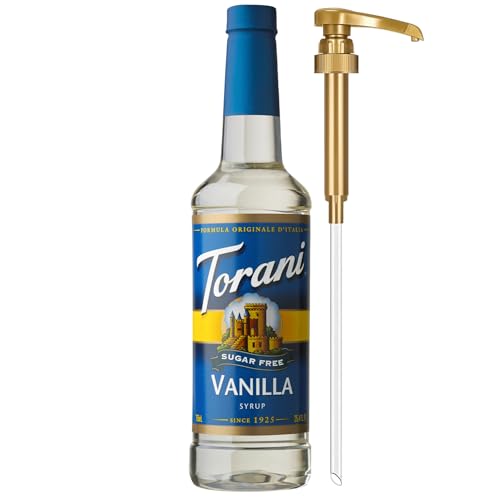
Torani Sugar-Free Vanilla Syrup (Pump Included, 25.4 fl oz)
The widest sugar-free flavour range of any brand here, in a 750 ml BPA-free bottle that ships with its own pump.

DaVinci Gourmet Sugar-Free Caramel Syrup (25.4 fl oz)
The cheapest per ounce on this list, from a Seattle brand that claims its sugar-free line resists curdling in dairy.

Jordan's Skinny Mixes Sugar Free Salted Caramel Coffee Syrup (12.7 fl oz)
A monk fruit, stevia and erythritol blend in a half-size bottle, for anyone avoiding sucralose by name.

Lakanto Simple Flavoring Syrup, Vanilla (25.4 fl oz)
Monk fruit paired with allulose, the sweetener that behaves most like sugar in the mouth. No pump in the box.

Collins Sugar Free Simple Syrup, Allulose and Monk Fruit (32 fl oz)
The only unflavoured pick, and the largest bottle here: a straight sugar-free stand-in for 1:1 simple syrup in iced coffee.

SubSugar French Vanilla Monk Fruit Sweetener Drops (8 oz Pump Bottle)
A monk fruit concentrate dosed in drops, not tablespoons, for anyone who tastes the erythritol chill in everything else.