Coffee Around the World: Traditional Brewing Methods and Coffee Cultures
 Tommie Chaney··Updated
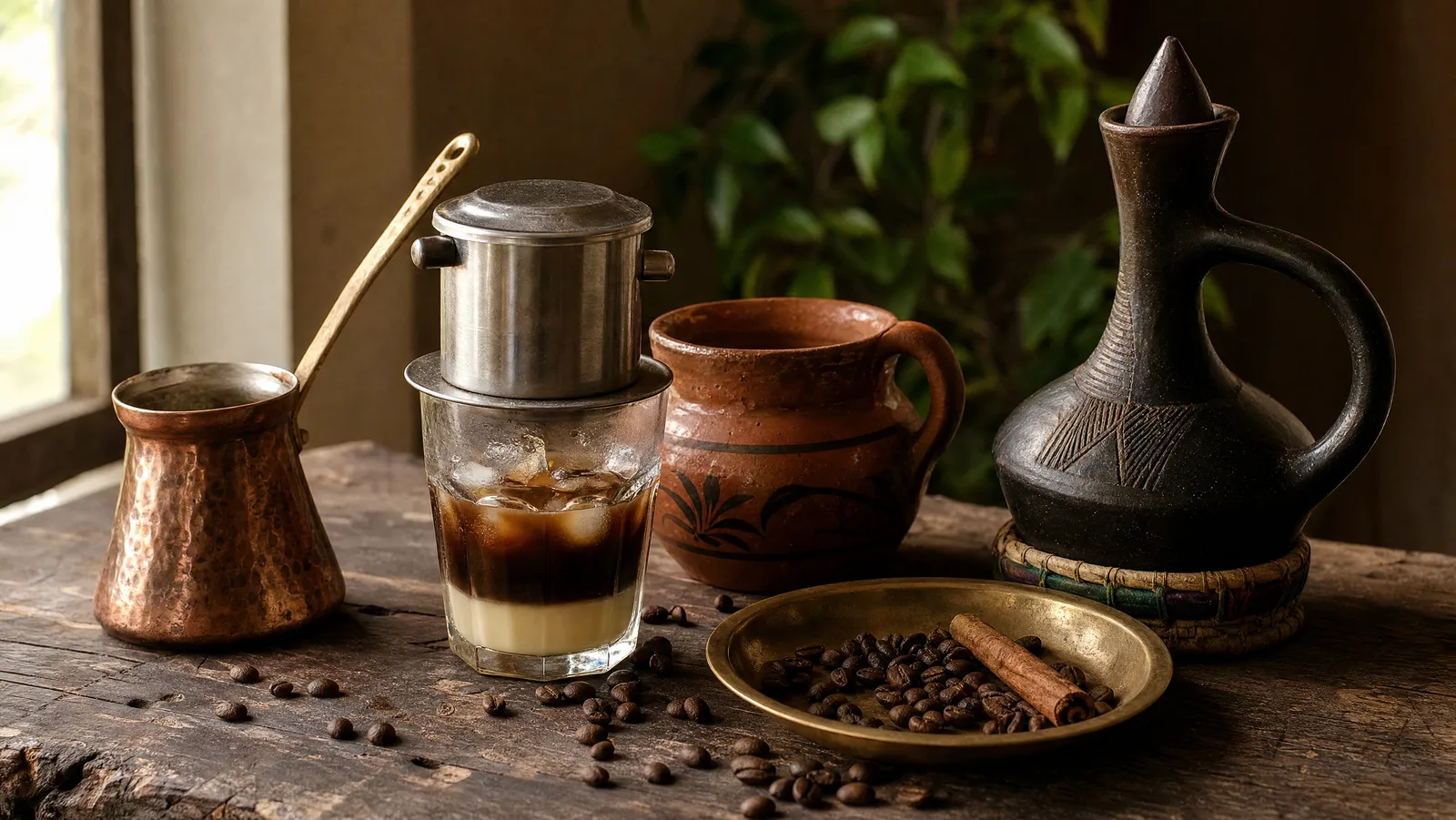
Coffee is brewed and drunk differently almost everywhere it lands, and the differences are not arbitrary. Look at how people drink coffee around the world and the same four variables keep reappearing — grind, water, vessel, ritual — each one bent to fit local fuel, local dairy, local sugar and local trade history. A Turkish cezve, a Vietnamese phin and a Mexican clay olla solve one problem three ways.
Sweeter Grind is reader-supported. We may earn a commission on purchases made through links on this site, at no extra cost to you.
If you want the modern, largely Western toolkit — V60, French press, AeroPress, drip machine, espresso — that lives in our guide to coffee brewing methods. This article is the other half of the map: the traditions that got there first, or developed in parallel and never needed third-wave approval. Nine cultures, one section each. What the tradition is, what makes the cup taste that way, and what gear defines it.
How Coffee Spread Around the World
The plant comes from Ethiopia. The drink, as a daily habit with rules attached, is first documented further east. Brewminate's history of coffee describes the earliest substantiated evidence of coffee drinking as mid-15th-century Yemen, among Sufi communities who used it to stay alert through nightly devotions.
From there the spread is traceable in writing. Wikipedia's history of coffee cites the 1587 treatise of Abd al-Qadir al-Jaziri, which charts coffee moving from Yemen to Mecca and Medina and then on to Cairo. For roughly two centuries, until the end of the 1600s, Yemen was effectively the world's only export gateway — which is why the port of Mocha ended up lending its name to a coffee, a chocolate drink, and eventually a stovetop pot in Italy.
That single-origin bottleneck matters for everything below. Coffee arrived in each new place as an expensive import, and each place brewed it with what it already owned: a long-handled copper pot, a clay cooking vessel, a steam laundry tub, a shaker meant for children's cocoa. Nobody designed a coffee brewer from scratch. They adapted.
Origin also shaped flavour. The regional profiles behind each tradition's choice of roast level and sweetener are covered in our guide to coffee growing regions and flavour profiles.
Turkey and the Middle East: Coffee Boiled in a Cezve
The cezve (also called an ibrik, a jezva, or a briki depending on where you are standing) is a small long-handled pot, usually copper or brass, wider at the base than the rim. Coffee, cold water and sugar go in together. The pot goes on low heat. Nothing is filtered out.
That last part sets every other variable. Because the grounds stay in the cup, the grind has to be finer than espresso — specialty roasters describe the target as closer to flour or powdered sugar than to sand, and several brewing guides note explicitly that espresso-fine is not fine enough. Powder settles into a sludge at the bottom instead of gritting up every sip, and it gives up flavour fast in a short, hot contact time. Our grind size guide shows where it sits relative to everything else.
Ratios vary by household. Copenhagen Coffee Lab's guide suggests roughly 6 to 8 grams per 60 to 80 ml of cold water, and a coffee scientist quoted by PopSci calls nine parts water to one part coffee the "magic ratio." Either way it is a concentrate.
The method's shape is consistent even where the numbers are not: start cold, keep the heat low so it takes three to four minutes, do not stir once the pot is on the flame, and lift it off as the foam climbs — before a true boil. Sources disagree on whether to return it for a second or third rise — a reasonable sign that it is family preference rather than physics. Sugar is decided before brewing, not after: sade (none), orta (medium), şekerli (sweet).
The cup that comes out is heavy-bodied, slightly syrupy, with fine suspended solids and a thick foam cap. The full mechanics of how to make Turkish coffee — pot size, heat management, how many rises, how to split the foam between cups — deserve their own article. What matters here is why it tastes like that: no filter, no paper, nothing removed.
UNESCO inscribed Turkish coffee culture and tradition on the Representative List of the Intangible Cultural Heritage of Humanity in 2013. A separate element, "Arabic coffee, a symbol of generosity," was inscribed in 2015 on a nomination from the UAE, Saudi Arabia, Oman and Qatar, with an extended version adding Jordan replacing it in 2024. That is a different cup: qahwa is typically lighter-roasted, often spiced with cardamom, and served from a dallah into small handleless finjān. UNESCO's material notes the etiquette — the oldest or most important guest is served first, and the cup is topped up rather than filled to the brim. Closely related cezve traditions run through Greece, Cyprus, Armenia, Bosnia and the Levant.
Vietnam: The Phin Filter and Ca Phe Sua Da
The phin is a small stainless or aluminium drip filter that sits directly on the glass: a chamber for grounds, a perforated base, and a loose press disc on top. Hot water goes in, and gravity does the rest over roughly four to five minutes. No pump, no paper, no pressure.
What makes the cup distinctive is the bean. Vietnam is the world's largest robusta producer, and the scale is not marginal — Vietnamese customs figures reported in state media put 2025 coffee export turnover above US$8 billion, a national record. Robusta tastes nothing like the washed Ethiopian arabica a specialty café pours: woodier, darker, bitterer in a cocoa-and-tyre direction, with low acidity and a heavier body. Our explainer on arabica vs robusta covers the species difference in detail.
Robusta also carries more caffeine, though the usual "twice as much" line oversells the precision: a 2025 HPLC study in Bio Web of Conferences measured robusta consistently higher than arabica at every roast level tested, and most comparisons land between 1.5 and 2 times.
Put a dark-roasted robusta through a slow gravity drip at a fine-to-medium grind and you get a short, thick, very bitter concentrate. Sweetened condensed milk is the counterweight — a pairing commonly explained by the scarcity of fresh dairy in the colonial-era supply chain, which is plausible but not something we have seen in a primary source. The canonical result is cà phê sữa đá: condensed milk in the bottom of the glass, concentrate dripped on top, stirred, poured over ice. Order it black and iced and it is cà phê đen đá. Hanoi's cà phê trứng whips egg yolk with condensed milk into a warm custard cap floated over the coffee.
The practical details of making Vietnamese coffee with a phin — grind, dose, the bloom, how tightly to seat the press disc — are their own topic. The shape to remember is simple: strong bean, slow drip, sweet counterweight, ice.
Mexico: Cafe de Olla in a Clay Pot
Café de olla is a decoction, not a drip. Water, piloncillo (unrefined cane sugar sold in hard cones) and a stick of canela go into an olla de barro — a glazed clay pot — and simmer until the sugar dissolves. Coarse-ground dark coffee goes in at the end, off or barely on the heat, steeps for a few minutes, and is strained as it is poured. Some households add orange peel, star anise or clove.
The origin story is less settled than the recipe. Mexican outlets including Excélsior and Uno TV report the popular account that ties the drink to the Mexican Revolution, roughly 1910 to 1917, and to the Adelitas who brewed coffee with cinnamon and piloncillo for troops on the move. Other accounts place it earlier, with coffee's arrival in Mexico in the 18th century, and at least one source describes the Revolution version as partly mythologised. We would treat it as living folk history rather than documented fact.
Two things make the cup. First, the sugar and spice are brewed with the coffee rather than stirred in after, so the piloncillo's molasses notes extract alongside it instead of sitting on top. Second, the vessel: unglazed or lightly glazed clay is widely described as contributing a mineral, earthy note that a steel pot does not, and new pots are usually seasoned before first use.
Roast level is not incidental here. A light, floral single origin is wasted against piloncillo and cinnamon; a medium-dark to dark roast has the caramel and cocoa backbone to meet them. Our guide to coffee beans and roasts covers how far down the roast curve you can go before the origin character disappears entirely. A full cafe de olla recipe, with the simmer timings and the strain, is a separate piece.
Greece and Cyprus: Frappe and Freddo
Greece runs two cold coffee traditions in parallel, and conflating them is the most common mistake visitors make.
The frappé is instant coffee, cold water, sugar and ice, shaken or blitzed until it carries a dense, long-lasting head of foam. Nescafé's own campaign material credits Dimitris Vakondios, working the Nestlé stand at the 1957 Thessaloniki International Fair, who could not find hot water and shook instant granules with cold water and ice instead — reportedly in a shaker meant for a children's cocoa drink. The story is not airtight: Greek Breakfast notes the company had already launched an iced instant product, and Greek consumer site Skroutz points to pre-1957 newspaper advertising, which would make Vakondios the inventor of the foam rather than of the drink.
Either way, the instant is load-bearing. Spray-dried coffee dissolves completely in cold water and its surfactants whip into a stable foam that freshly brewed coffee will not reproduce. Substituting "real" coffee does not upgrade a frappé; it makes a different, flatter drink.
The freddo is the espresso-based answer that arrived later. A double shot is pulled, shaken or stirred hard with ice to chill it without dilution, and poured over fresh ice — that is a freddo espresso. Add cold-frothed milk, whipped with a hand mixer into a thick, spoonable foam, and it is a freddo cappuccino. Sweetness is specified at order time: sketos (none), metrios (medium), glykos (sweet).
Cyprus drinks freddo too, alongside its own cezve-brewed coffee, named locally rather than by reference to anyone else's tradition. The distinctions between Greek frappe and freddo espresso, and how to build each at home, are worth a dedicated article.
Cuba: Cafecito, Colada and Espuma
Cuban coffee is a technique more than a recipe, and the technique is espuma — or espumita, the diminutive you will actually hear.
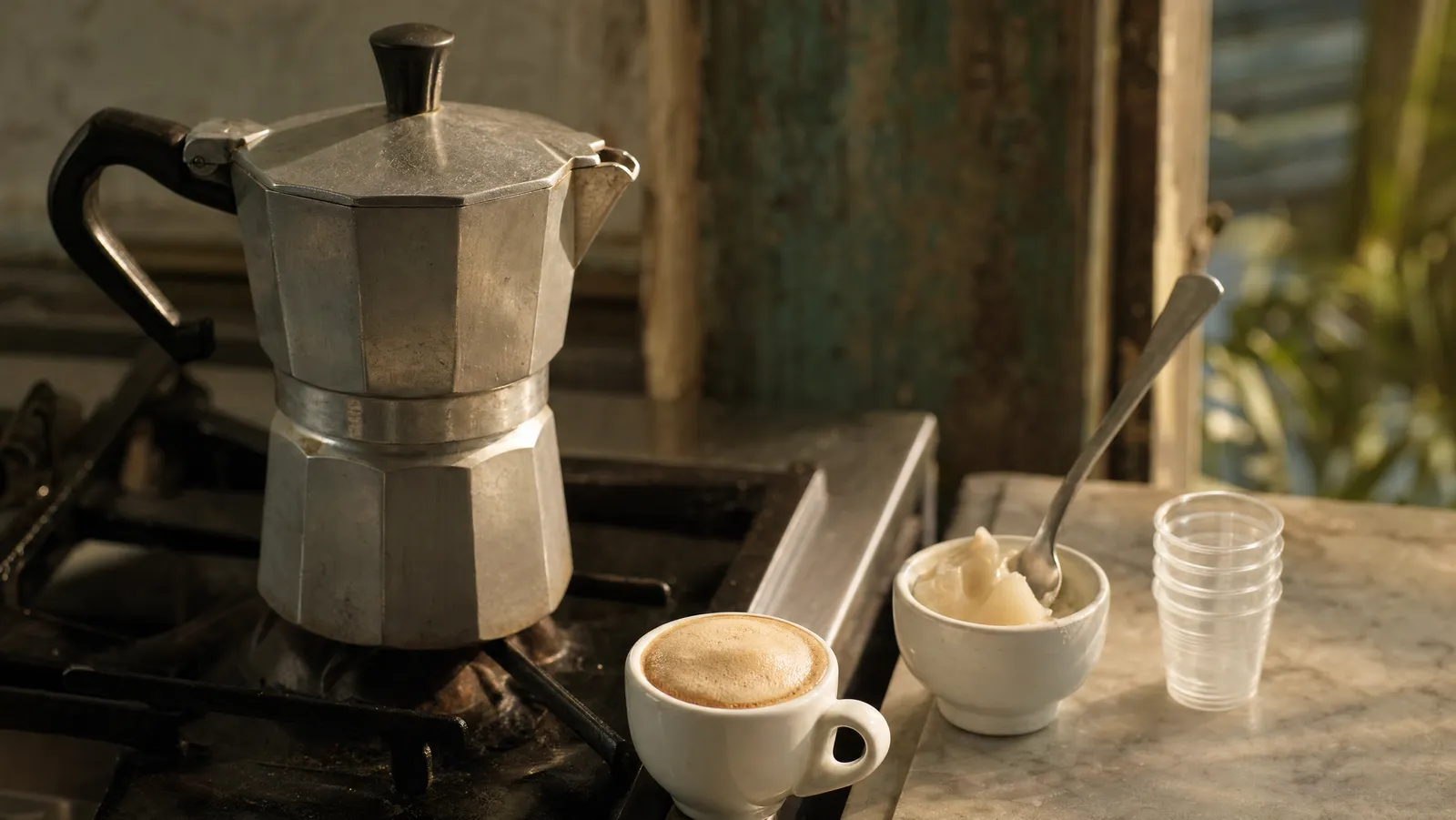
Coffee is brewed dark and strong in a stovetop cafetera — a moka pot; Mayorga's guide specifies a dark roast at an espresso-fine grind and says to brew in a cafetera, never drip. The first few drops out of the pot are caught in a cup or small pitcher with sugar and beaten hard against the side with a spoon until they turn into a pale, thick paste. Barista Magazine's piece on café cubano describes the rest of the brew then being poured over that paste, which lifts into a tan crema on top.
It is beaten, not stirred. That distinction is the whole drink: whipping concentrated hot coffee into sugar emulsifies it into something closer to a foam than a syrup, and pre-dissolving the sugar changes how the bitterness of a dark roast reads on the palate.
The rest is a matter of size and dairy. A cafecito is the single sweetened shot. A colada is the shareable version — commonly described as about four ounces — handed over with a sleeve of thimble-sized cups so an office or a job site can split it. A cortadito cuts it with steamed or evaporated milk; café con leche stretches it into breakfast. In Miami it runs through the ventanita, the walk-up window, where the espumita is whipped in front of you.
The step-by-step of how to make Cuban coffee at home — how much sugar, when to pull the pot, how hard to beat — is its own article. The one-line version: catch the first drops, beat them to a paste, pour the rest over.
South India: Filter Coffee and the Davara Tumbler
The South Indian coffee filter is a two-chamber metal cylinder, usually stainless steel or brass. The upper chamber has a perforated base and a pressing disc; ground coffee goes in, gets lightly tamped, and hot water is poured over. The liquid — the decoction — drips into the lower chamber over ten to twenty minutes by published guides, longer in some households.
The blend is where it diverges hardest from third-wave norms. Roasted chicory root is ground in with the coffee, commonly at around 20 to 30 percent, though described ranges run from none at all up to 40 percent. Chicory contributes no caffeine; it adds colour, a dark bittersweet edge and noticeably more body, and it holds up to the volume of milk the drink is built on. Historically it also stretched an expensive import.
Serving is a fixed ratio rather than a free pour. Roughly one part decoction to three parts hot milk, sweetened, is the common proportion across published recipes. The beans are usually an arabica-robusta blend from the Indian growing belt — Chikmagalur, Coorg, Wayanad.
Then there is the pour. The drink is moved repeatedly between a tumbler and a davara (also spelled dabara), the wide-lipped metal saucer it sits in, at increasing distance — sometimes at full arm's length. This is not showmanship. It aerates the milk, builds a light foam, mixes the decoction evenly and drops the temperature to something drinkable in a vessel that conducts heat straight to your fingers. The mechanics of South Indian filter coffee, including how finely to grind for the metal filter, come with their own guide.
Ethiopia: The Coffee Ceremony and the Jebena
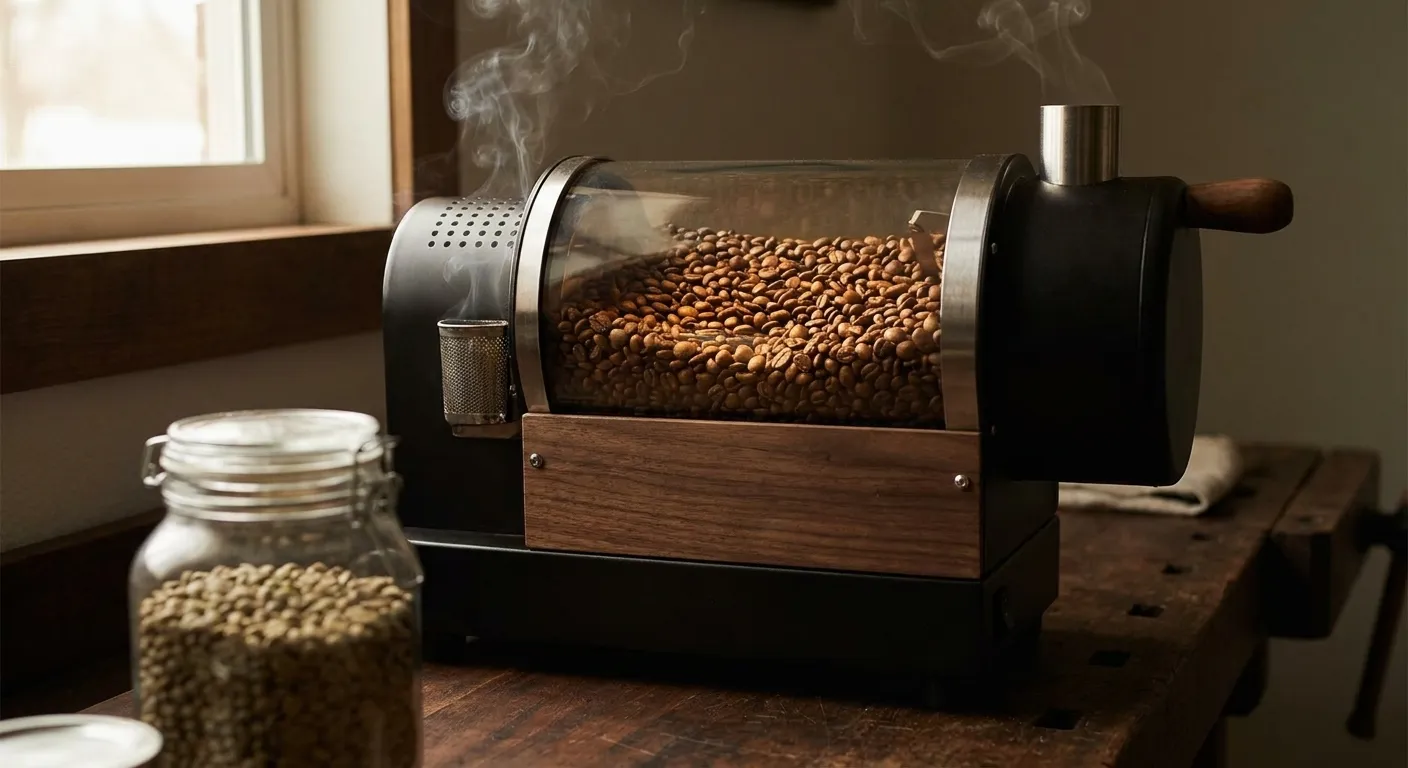
In Ethiopia the brewing is the smallest part of the event. Green beans are washed and roasted in a flat pan over coals in front of the guests, so the room fills with roasting smoke; frankincense is often burning alongside. The beans are ground by hand, traditionally in a wooden mortar, and brewed in a jebena — a round-bellied clay pot with a narrow neck and a long spout. The pot is boiled, rested so the grounds settle, and poured from a height in a thin stream into small handleless cups.
It is served three times from the same grounds. Barista Magazine's account of a morning with the jebena names the rounds abol, tona and baraka — the first the strongest, the last meaning "blessing," and leaving before it is poured is considered rude. In Tigrinya the three are awel, kale'i and baraka. Snacks — popcorn, roasted barley — usually circulate between rounds.
The cup is heavy and aromatic in a way no other method reproduces, for a mechanical reason: the coffee was green twenty minutes ago. Roasting immediately before brewing keeps volatile aromatics that normally fade over days, and because the brew is boiled and unfiltered, body and sediment come with them. Sweetening varies regionally, and in some areas salt or butter goes in instead of sugar.
One correction worth making, because the opposite is repeated everywhere: the ceremony is not currently on UNESCO's Representative List. UNESCO reported in 2025 that Ethiopia was still preparing its nomination file, with support from UNESCO's Regional Office for Eastern Africa.
If reading about the Ethiopian coffee ceremony leaves you wanting the beans, washed and natural Ethiopians from Yirgacheffe, Guji and Sidamo are a staple of almost every US specialty roaster in our roaster directory.
Japan: Siphons, Kissaten and Flash-Chilled Iced Coffee
Japan's contribution is not a vessel but a standard of care, practised in the kissaten — the traditional coffee house, distinct from a modern café. Japanese Taste dates the first kissaten to 1888 in Tokyo. A widely circulated figure puts their 1980s peak above 150,000, though we have found no official count to confirm it.
Three techniques define the old kissaten cup:
- Siphon (saifon). Vacuum brewing was invented in 19th-century Europe and largely abandoned there, but Japan kept refining it. Vapour pressure pushes water from the lower globe into the upper chamber, it steeps with the grounds, then the heat is cut and the vacuum pulls it back down through a cloth or glass filter. Full immersion with a clean filtered finish, and a visible show attached.
- Nel drip. A flannel cloth filter, hand-poured, usually with a dark or aged roast. Cloth passes more oils than paper and traps more fines than metal, which is why the result gets described as velvety or almost syrupy.
- Hand drip. The precision lineage that produced the conical drippers now standard in specialty cafés worldwide.
Then there is the cold version. Flash chilling — called Japanese iced coffee outside Japan — brews hot at full strength directly onto ice, so the cup is chilled within seconds of extraction rather than over hours. Part of the brew water is replaced by the ice, so the ratio still works out.
Having Japanese iced coffee compared with cold brew side by side is the clearest way to understand both. Our cold brew guide covers the long-steep route, typically 12 to 18 hours, which specialty sources consistently describe as lower in perceived acidity and heavier on chocolate and nut notes. Flash-chilled coffee goes the other way: bright, floral, acidic, tasting much like the hot cup. The standard explanation is that fast chilling traps aromatics that slow cooling lets escape — widely repeated, but not something we have seen backed by published measurement.
Italy: Moka Pots, Espresso Bars and Ordering Like a Local
Italy exported two things: the espresso bar, and the pot that put coffee on every domestic stove.
Alfonso Bialetti designed the Moka Express in 1933; the Irish Times describes the octagonal Art Deco body that is still in production, and the pot sits in MoMA's collection. The inspiration, repeated across Italian sources, was a lisciveuse — a sealed laundry tub that used steam pressure to push soapy water up through clothes. Domus notes the name points at Mocha in Yemen. Renato Bialetti took over in 1946 and made it a national object. Attribution is not unanimous: Open Culture credits employee Luigi De Ponti with the design.
A moka pot is not an espresso machine, and the gap is mostly pressure. Steam pressure in a moka is commonly cited at around one to two bar, against the roughly nine bars conventionally used for espresso — so there is no true crema and far less emulsified oil. What you get is a thick, low-acid, intensely concentrated cup. The practical levers are a fine-but-not-espresso grind, a level fill with no tamping, and pulling it off the heat at the first gurgle; our moka pot brewing guide walks through the sequence. Note that a moka is the same pot Cuban espumita is built on, so one purchase covers two traditions. Picking among the best moka pots — aluminium versus steel, induction compatibility, sizing — is a buying question rather than a technique one.
The bar is the other half. Order at the counter and a caffè means a single espresso, drunk standing, usually in under two minutes. Italian espresso blends often include robusta for body and a more persistent head, which is why a bar espresso reads heavier than a single-origin arabica shot. A macchiato is an espresso "stained" with a little milk, a marocchino layers cocoa and milk foam, a corretto adds grappa or sambuca. The cappuccino-is-a-morning-drink convention is widely observed, but it is a custom, not a rule.
Italy's affection for the ritual has not translated into heritage status. ANSA reported in March 2022 that Italy's own national UNESCO commission rejected the espresso nomination, backing an Italian opera bid instead, partly because competing applications had been submitted.
What Traditional Coffee Drinks Around the World Have in Common
Nine traditions, and four patterns keep surfacing.
Most of them do not use paper. Cezve, jebena, olla, moka, phin, South Indian filter, nel drip — metal, cloth, clay or nothing at all. Paper strips oils and fine particles, which is why so many of these cups read as heavier and more textured than a V60.
Sweetener is usually a brewing ingredient, not a topping. Sugar in the cezve, piloncillo in the olla, sugar whipped into espumita, condensed milk under the phin, sugar shaken into the frappé. Adding sugar during extraction or emulsifying it into hot concentrate is not the same as stirring it into a finished cup.
The vessel is cheap and local. Almost nothing in this article costs more than a mid-range grinder. These are kitchen objects.
Ritual is the point. Three rounds in Ethiopia, the shared colada, the hour-long frappé, the two-minute espresso at the bar. Coffee culture around the world is mostly an agreement about how long you are allowed to sit down.
One more thing worth saying plainly. Specialty coffee's standard brew-water window — widely cited as 195 to 205 degrees Fahrenheit, about 90 to 96 Celsius, from the SCA's Golden Cup guidance — describes filter brewing. Several methods above sit outside it deliberately: Turkish coffee and café de olla go to a near-boil or past it, and the frappé never uses hot water at all. They are not failing a standard; they are not playing that game.
Choosing a Traditional Brewer
If a section above caught your interest, here is roughly what it costs. Prices are approximate ranges that move a lot by material and size.
| Vessel | Rough price | Makes | Also useful for |
|---|---|---|---|
| Copper or brass cezve, 2-4 cup | about $25-$55 | Turkish-style coffee | Nothing else, honestly |
| Stainless phin, 1 cup | about $8-$20 | Vietnamese concentrate | Single-cup drip concentrate |
| Clay olla, 1-2 L | about $15-$30 | Café de olla | Herbal teas, atole, mulled drinks |
| Aluminium moka pot, 3-6 cup | about $25-$45 | Moka coffee | Cuban cafecito and colada |
| Stainless South Indian filter | about $20-$40 | Decoction for milk coffee | Any strong milk-based coffee |
| Jebena | about $25-$60 | Ceremony coffee | Any boiled, unfiltered coffee |
| Glass siphon, 3-5 cup | about $70-$150 | Siphon coffee | Demonstrations, clean light roasts |
Start with the phin. It is the cheapest entry here, nearly unbreakable, needs no filters, and makes something genuinely different from anything a drip machine does. Among the best Vietnamese phin filters, differences come down to how tightly the base perforations are punched, which sets the drip rate.
The cezve has a hidden prerequisite. Powder-fine grinding is beyond most burr grinders in the $50 range, and forcing it tends to clog, which is why many people buy pre-ground Turkish coffee or a hand mill that goes that fine. Shopping for the best cezve and Turkish coffee pots is mostly a question of metal, capacity and handle length — but check your grinder first.
The siphon is the splurge, and it is the one most likely to end up in a cupboard. It makes a clean, aromatic cup and a genuine spectacle, but the cloth filter needs washing and replacing, and the glass is fragile. Comparing the best siphon coffee makers comes down to filter type and heat source more than brand.
Two notes apply to all of them. First, these methods use ratios that look alarming next to filter coffee, and converting between a 1:9 cezve brew and a 1:16 pour-over is not intuitive — our brew ratio calculator handles the arithmetic. Second, buy beans suited to the method: a dark robusta blend for the phin, a medium-dark for the olla and the cafetera, a fresh natural Ethiopian for the jebena, a light washed coffee for the siphon.
Frequently Asked Questions
What is coffee culture?
Coffee culture is the set of shared habits around how coffee is prepared, served and consumed in a place — the vessel, the ratio, the sweetener, the time of day, how long you may linger, and who is served first. It is why an Italian espresso is a two-minute transaction at a counter and an Ethiopian ceremony runs for an hour across three rounds, even though both are hot water and ground coffee.
Which traditional coffee method is the strongest?
By concentration, the Vietnamese phin and the Cuban cafetera shot are the most intense — both are short, dark-roast concentrates rather than brewed cups. Turkish coffee is comparable and, because it is unfiltered, delivers more suspended solids. By caffeine per serving the phin usually wins, since robusta carries more than arabica — but servings are small, so a 12-ounce drip coffee can still hold more total caffeine than a 2-ounce cafecito.
Do I need special beans for these methods?
Not special, but suited. Robusta or a robusta-heavy blend is the right call for the phin and helps in an Italian-style moka. Dark and medium-dark roasts stand up to the sugar and spice in café de olla and Cuban coffee. Turkish coffee needs a powder grind, which usually means pre-ground or a hand mill that reaches that fine. The siphon and the jebena reward lighter, fresher, more aromatic coffee.
Is Turkish coffee the same as Greek or Bosnian coffee?
Mechanically they are near-identical: powder-fine grind, a small long-handled pot, cold water start, sugar added before brewing, nothing filtered. The differences are in naming, pot shape, foam handling and whether the pot returns to the heat. The naming is contested and in places politically sensitive, so the courteous approach is to use the local name.
Which coffee traditions does UNESCO actually recognise?
Two, as far as coffee preparation goes: Turkish coffee culture and tradition, inscribed on the Representative List in 2013, and "Arabic coffee, a symbol of generosity" in 2015, with an extended multinational version replacing it in 2024. Ethiopia's ceremony was still at the file-preparation stage when UNESCO reported on it in 2025. Viennese coffee house culture is often described as a UNESCO listing but has been on Austria's national inventory since 2011, which is a different thing. Italy's espresso bid was rejected by Italy's own national commission in 2022.
Is a moka pot the same as espresso?
No. A moka brews at roughly one to two bar of steam pressure against the nine bars conventionally used for espresso, so there is no real crema and much less emulsified oil. It makes a thick, low-acid concentrate that works well in milk and in Cuban-style drinks, but it is its own category rather than a budget espresso machine.
Explore the full series
- How to Make Turkish Coffee in a Cezve — the cezve method, the powder-fine grind, and how to build the foam
- How to Make Vietnamese Coffee With a Phin Filter — the phin filter, robusta beans, and ca phe sua da step by step
- Café de Olla: The Mexican Clay-Pot Coffee Recipe — piloncillo, canela and why the clay pot matters
- Greek Frappé and Freddo Espresso, Explained — shaken instant frappe, freddo espresso and freddo cappuccino
- Cuban Coffee: Cafecito, Colada and Espuma — beating espuma, pulling a cafecito, and sharing a colada
- South Indian Filter Coffee and the Davara Tumbler — the two-chamber filter, chicory blends and the davara pour