How to Make Vietnamese Coffee With a Phin Filter
 Tommie Chaney·
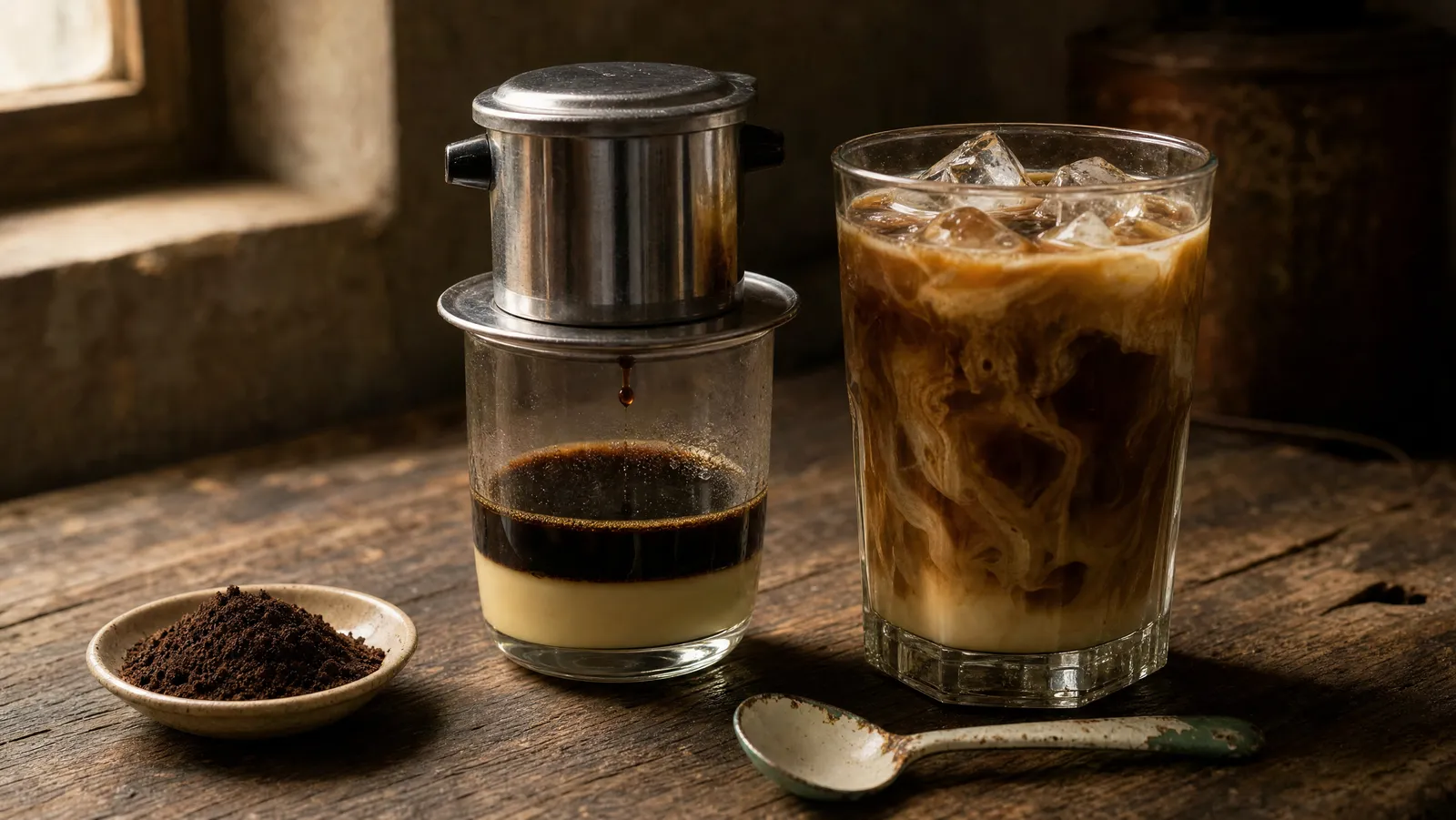
To make Vietnamese coffee with a phin, you put about 15-20 g of medium to medium-coarse grounds in the small metal chamber, bloom them with a splash of near-boiling water, set the insert down lightly on top, fill the chamber, and let gravity drip the coffee over 4-5 minutes — straight onto sweetened condensed milk in the glass below.
Sweeter Grind is reader-supported. We may earn a commission on purchases made through links on this site, at no extra cost to you.
That is the whole machine: a cup, a perforated steel tin, and patience. No moving parts, no pour technique to master. The phin sits alongside the cezve and the moka pot in our guide to coffee around the world as a method that makes something a dripper cannot — cà phê sữa đá, Vietnamese iced coffee, bitter-sweet and syrupy over ice. Here is how to get there, and why each number matters.
What a Phin Actually Is
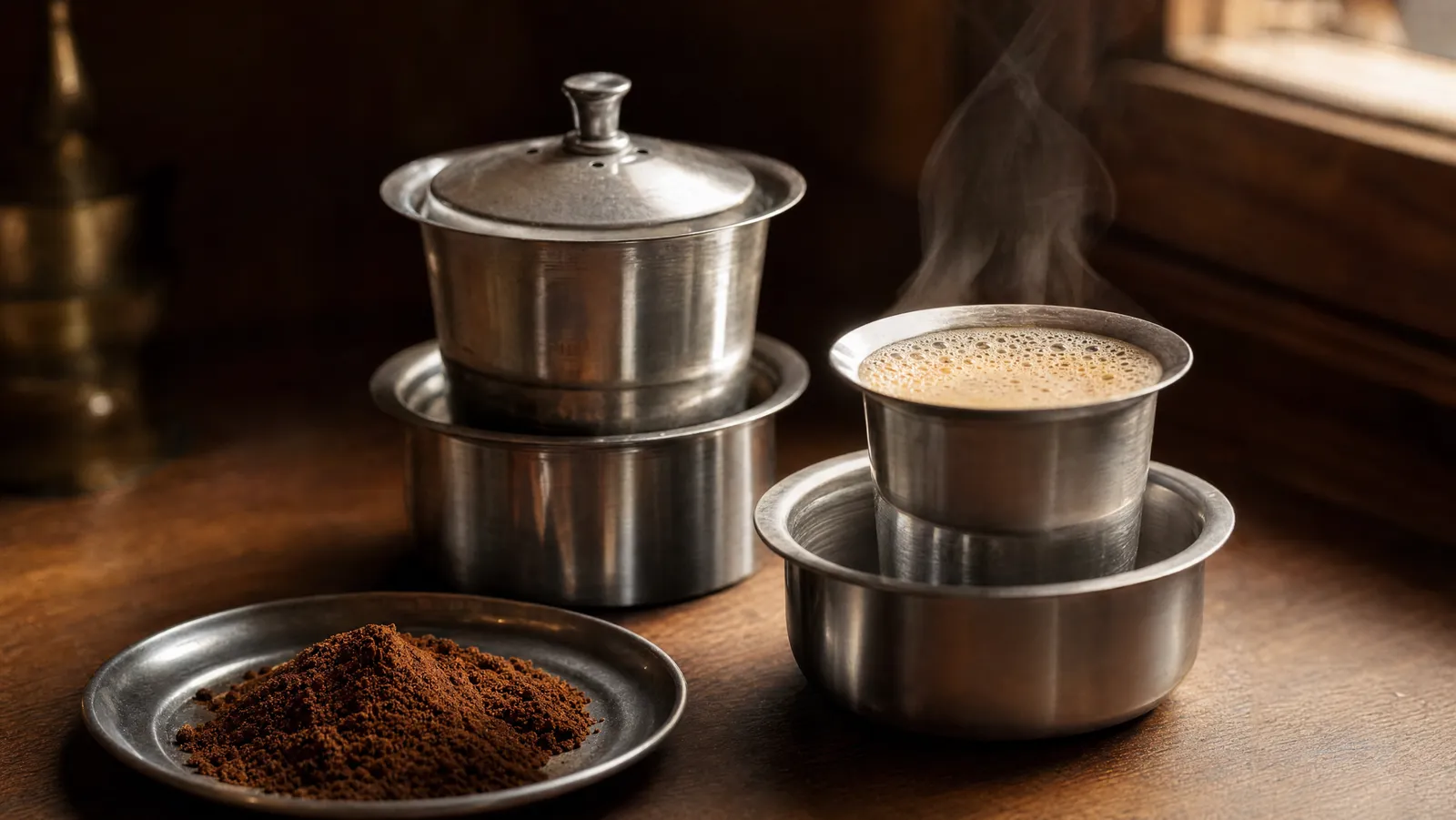
A phin is a small stainless steel gravity dripper, usually 8 oz or 12 oz, that sits directly on the cup you drink from. Four parts: a base plate that rests on the rim, a chamber with a perforated bottom, an insert, and a lid.
There is no paper filter. That single fact explains most of the taste difference: paper traps coffee oils and the finest particles, perforated steel does not. What lands in your glass keeps its oils and a little sediment, which reads on the palate as weight and texture.
The second difference is contact time. A V60 is done in roughly three minutes of fast-moving water; a phin takes 4-5 minutes with water sitting on a packed bed, trickling through under nothing but its own weight.
A useful shortcut: a phin tastes closer to a French press than a pour over — heavy-bodied, round, a little grit at the bottom — but far more concentrated than either, because the ratio is tighter. It belongs to the tradition of unfiltered brewing, the same lineage as how to make Turkish coffee, where the grounds and oils are part of the cup rather than something to strain out.
The Beans: The Part People Get Wrong
You can brew anything in a phin. But if you want the drink you had in Hanoi, you need robusta, or a robusta-heavy blend.
Vietnam is the world's second-largest coffee producer and the dominant robusta supplier. According to Viet Nam News reporting on USDA figures in May 2026, Vietnam was forecast to produce 30.8 million 60-kg bags in 2025/26 — behind Brazil at roughly 63 million — with robusta nearly 95% of that output. Most of that crop grows in the Central Highlands, where Đắk Lắk is the largest coffee-producing province.
Robusta is a different species, Coffea canephora, and it behaves differently: lower acidity, more bitterness, heavier body, flavours running toward dark chocolate, tobacco and grain rather than fruit. We cover the full comparison in arabica vs robusta explained, but the short version for phin purposes is this: the thing people call "harsh" about robusta is exactly what makes condensed milk work.
Sweetened condensed milk is extremely sweet and extremely thick. Pour it into a delicate washed Ethiopian and you have erased the coffee. Pour it into dark-roasted robusta and you get balance: the bitterness pushes back, the dairy fat carries the body.
On caffeine: a 2016 Phytochemistry study of green beans from multiple origins found that C. canephora always showed higher caffeine content than C. arabica, and the gap is commonly cited as roughly double by dry weight — though published figures vary by origin and variety, so treat any specific multiple as approximate. A higher-caffeine species brewed as a concentrate hits harder than the cup size suggests; our caffeine calculator will estimate your intake.
What to buy. Trung Nguyên is the brand most often cited outside Vietnam, and phin sellers routinely suggest it by name — though its G7 label is best known for instant sachets, which are not what goes in a phin. You want ground coffee. Plenty of US roasters stock Vietnamese robusta and robusta-arabica blends too. And to be clear: a light-roast Ethiopian arabica in a phin will work. It just will not taste like Vietnamese coffee.
The Grind: Medium to Medium-Coarse
This is the variable that decides whether your phin behaves. Target medium to medium-coarse — between table salt and coarse sand, not espresso-fine.
Guides genuinely disagree. Nguyen Coffee Supply recommends going finer for its own filters — "fine, like sand", somewhere between a pour over and an espresso; Coava Coffee Roasters' published phin recipe simply says medium; MyCoffeeExplorer's glossary calls for medium-coarse outright.
The mechanism explains the disagreement. The phin has fixed hole sizes and no pressure. Grind too fine and the bed compacts, the holes clog, and the brew either stalls or takes twenty minutes and tastes scorched. Grind too coarse and water sheets through in 90 seconds, leaving hot brown water. Hole pattern, dose and insert weight all shift the sweet spot, which is why guides built around different hardware disagree.
Use drip time as your feedback loop, not a grind chart. If the brew finishes in 4-5 minutes, your grind is right for your phin, whatever you call it. Our grind size guide has the visual reference.
The Ratio and the Numbers
Phin ratios are tighter than filter-coffee ratios, and recipes vary. Copper Cow Coffee's guide suggests about 2 tablespoons — roughly 14 g — for a single-serve phin, while Coava Coffee Roasters publishes a stronger 16 g coffee to 100 g water. Here is where we would start, on an 8 oz phin:
| Element | Amount |
|---|---|
| Coffee | 16-20 g (medium to medium-coarse) |
| Water | 100-120 ml, just off the boil |
| Sweetened condensed milk | 20-30 ml (about 1.5-2 tbsp) |
| Ice | A full glass, added at the end |
| Total drip time | 4-5 minutes |
Water temperature: Copper Cow Coffee's phin guide recommends 190-205°F (88-96°C), or just below a boil with no thermometer. The upper end is hotter than you would use for a delicate arabica, and that is appropriate here — dark-roasted robusta needs the energy and nothing fragile is at risk. To scale up for a 12 oz phin, our brew ratio calculator does the arithmetic.
Gravity Insert vs Screw-Down
There are two designs, and they are not interchangeable.
The gravity insert is a loose perforated disc you set on the grounds; its own weight does the tamping. This is the common modern design and the easier one to live with, because there is nothing to over-tighten.
The screw-down press threads onto a central post, so you can tighten it to slow the flow or back it off to speed it up. More control, more ways to ruin a brew — screw it down only until it lightly touches the bed, because over-tightening is the commonest cause of a phin that refuses to drip.
Either way: press lightly. You are levelling the bed, not building an espresso puck.
Beyond that the choice is capacity — 8 oz for one strong cup, 12 oz for a bigger dose or two servings. The three stainless phins below run from about $10.95 to about $14.99 as of November 2026, so this is not a high-stakes purchase. A fuller breakdown of the best Vietnamese phin filters is planned separately.
How to Make Cà Phê Sữa Đá, Step by Step
Step 1: Add the condensed milk to the glass
Spoon 20-30 ml (about 1.5-2 tbsp) of sweetened condensed milk into a heatproof glass. It goes in first — the hot brew dripping onto it is what dissolves it properly.
Step 2: Weigh and grind the coffee
Grind 16-20 g of dark-roasted robusta at medium to medium-coarse. Grind it now, not an hour ago.
Step 3: Rinse the phin and seat it on the glass
Pour a little hot water through the empty phin into the sink, so the steel does not chill the first of your brew. Set it squarely on the rim, add the grounds, and tap the chamber gently to level the bed.
Step 4: Bloom the grounds
Set the insert on the grounds and pour just enough hot water to cover it — roughly 30 ml. Nguyen Coffee Supply's traditional phin guide suggests 1 oz, about half an inch of water above the press, and a 45-second bloom. Trapped carbon dioxide makes the bed swell and foam; fresh coffee blooms visibly, stale coffee barely moves.
Step 5: Fill the chamber and cap it
Top up to 100-120 ml total water and lid it to hold heat. Do not press the insert again. Walk away.
Step 6: Let it drip for 4-5 minutes
Nguyen Coffee Supply's guide suggests the first drip within about two minutes and the last around the five-minute mark, and phin guides commonly describe the target rate as roughly one drop every second or two. Resist the urge to lift the lid and poke at it.
Step 7: Stir, then pour over ice
Lift the phin off — set it on the inverted lid, it will drip — and stir coffee and condensed milk until the glass is a uniform caramel colour. Then fill a second glass to the brim with ice and pour the sweetened concentrate over it.
That order matters. Brewing directly over ice melts the cubes as you go and dilutes the coffee, which is the most common way a home cà phê sữa đá ends up watery.
The Hot and Black Versions
Cà phê sữa nóng (hot milk coffee) is identical minus the ice: brew onto the condensed milk, stir, drink. Nothing dilutes it, so dial the milk back to roughly 15-20 ml.
Cà phê đen is the black version, usually served with a little sugar instead of milk, hot (nóng) or iced (đá). With no dairy to hide behind, bean quality is fully exposed — the honest way to taste your robusta.
If condensed milk is sweeter than you want, syrups and sugars behave very differently in cold coffee; we go through the options in how to sweeten iced coffee. And if you are chasing iced coffee generally, phin-over-ice is a different animal from slow-steeped concentrate — we have a piece on Japanese iced coffee compared with cold brew in the works.
Troubleshooting
| Symptom | Likely cause | Fix |
|---|---|---|
| Drips too fast (under 3 min) | Grind too coarse; dose too small | Grind finer, or add 2-3 g; with a screw-down press, tighten slightly |
| Drips too slow (over 6 min) | Grind too fine; insert pressed too hard; cold phin | Grind coarser; set the insert down without pressing; rinse with hot water first |
| Stops entirely | Clogged holes, or suction from very fresh coffee | Nguyen Coffee Supply attributes fresh-coffee stalls to CO2 degassing working against the downward press, and suggests slipping in a spoon or chopstick to lift the insert and release the pressure. Check the holes are clear before brewing |
| Tastes thin and sour | Under-extracted: too coarse, too fast, water too cool | Grind finer, push water toward 200°F, extend the drip toward 5 min |
| Tastes harsh and ashy | Over-extracted: too fine, drip ran long | Grind coarser, reduce the dose slightly, aim for 4 min |
Silt at the bottom of the glass is normal for an unfiltered method. If it is thick enough to chew, grind coarser.
The Phin's Place in Vietnamese Life
This is a living everyday practice, not a novelty brewer.
Coffee arrived under French colonial rule — the introduction is commonly dated to 1857 and attributed to French missionaries, though accounts differ on the year and rarely cite primary documents. The usual explanation for condensed milk is practical: fresh dairy was scarce, expensive and hard to keep in a tropical climate. Vietnamese travel and food sources repeat that account widely, but read it as the common narrative rather than settled scholarship.
What is documented is the status the tradition now holds. Vietnam's Ministry of Culture, Sports and Tourism granted national intangible cultural heritage status to Đắk Lắk's coffee cultivation and processing knowledge in March 2025, and as of the World Coffee Heritage Forum in Đắk Lắk in April 2026 a dossier seeking UNESCO recognition was still being prepared. Nationally recognised, then — not yet UNESCO-listed. Anyone calling Vietnamese coffee "UNESCO heritage" is ahead of the paperwork.
The social shape matters too. Vietnamese café culture is widely described as lingering rather than transactional, with cafés working as workspaces and meeting places. The four-minute drip is part of the appeal, not a delay to engineer away.
Frequently Asked Questions
What coffee should I use in a phin?
Dark-roasted robusta, or a robusta-heavy blend. Vietnam's output is nearly 95% robusta according to USDA figures reported by Viet Nam News, and that species gives the drink its low acidity, heavy body and bitter-sweet edge — the profile that stands up to condensed milk. Trung Nguyên is the most cited brand abroad. Arabica brews fine in a phin; it just will not taste like this drink.
What grind size works best in a phin filter?
Medium to medium-coarse, roughly between table salt and coarse sand — not espresso-fine. Guides disagree, some recommending finer, because hole size and insert weight differ between phins. Use total drip time as your calibration: 4-5 minutes means your grind is right for your hardware.
How long should a phin take to drip?
Aim for 4-5 minutes total. Nguyen Coffee Supply's guide suggests the first drip within about two minutes and the last around five. Under three minutes means your grind is too coarse; past six means too fine, or the insert pressed too hard.
Can I use regular milk instead of condensed milk?
You can, but it is a different drink. Sweetened condensed milk contributes sugar, fat and viscosity at once, which is why it balances a concentrated robusta brew so well. Whole milk plus sugar gets partway there, with a noticeably thinner texture. Barista-formulated oat milk is a decent dairy-free substitute.
Is Vietnamese coffee stronger than regular coffee?
In caffeine terms, usually yes, for two compounding reasons: robusta carries more caffeine than arabica — a 2016 Phytochemistry study of green beans found C. canephora consistently higher, with the gap commonly cited as roughly double by dry weight — and a phin brews a concentrate rather than a full-length cup. Figures vary by origin, roast and dose, so treat specific numbers as estimates.
Start Here
Buy a cheap stainless phin, a bag of dark Vietnamese robusta, and a tin of sweetened condensed milk. Brew one cup at 18 g of coffee to 110 ml of water, time the drip, and change exactly one thing next time.
That is the entire learning curve. The phin asks almost nothing in technique — no pour rate, no pressure, no windows measured in seconds — which is why it survives unchanged as a daily brewer. It is also a useful lens on the rest of the world's coffee: once you have tasted what no-paper, long-contact brewing does to a cup, the logic behind a lot of traditional coffee brewing methods around the world stops looking quaint and starts looking deliberate.
Set it on the glass, put the lid on, and let gravity do the work.

Thang Long Vietnamese Coffee Filter, 8 oz
A plain 8 oz stainless steel phin made in Vietnam, built around a gravity insert rather than a screw-down press. It is dishwasher safe, the seller states a lifetime warranty, and the seller suggests pairing it with traditional ground coffee such as Trung Nguyên.

Birdee Stainless Steel Phin Filter, 8 oz
An 8 oz stainless steel phin made in Vietnam that sits on most mugs and glasses rather than requiring a specific cup. Birdee states it brews in roughly 3-5 minutes, which lines up with the drip window phin guides generally aim for, and the whole thing is dishwasher safe.

Birdee Vietnamese Coffee Dripper, 12 oz
A 12 oz stainless steel phin with a larger chamber that holds a bigger dose for a stronger brew, and that Birdee lists as working for both hot and iced preparations. Dishwasher safe.