How to Make Turkish Coffee in a Cezve
 Tommie Chaney·
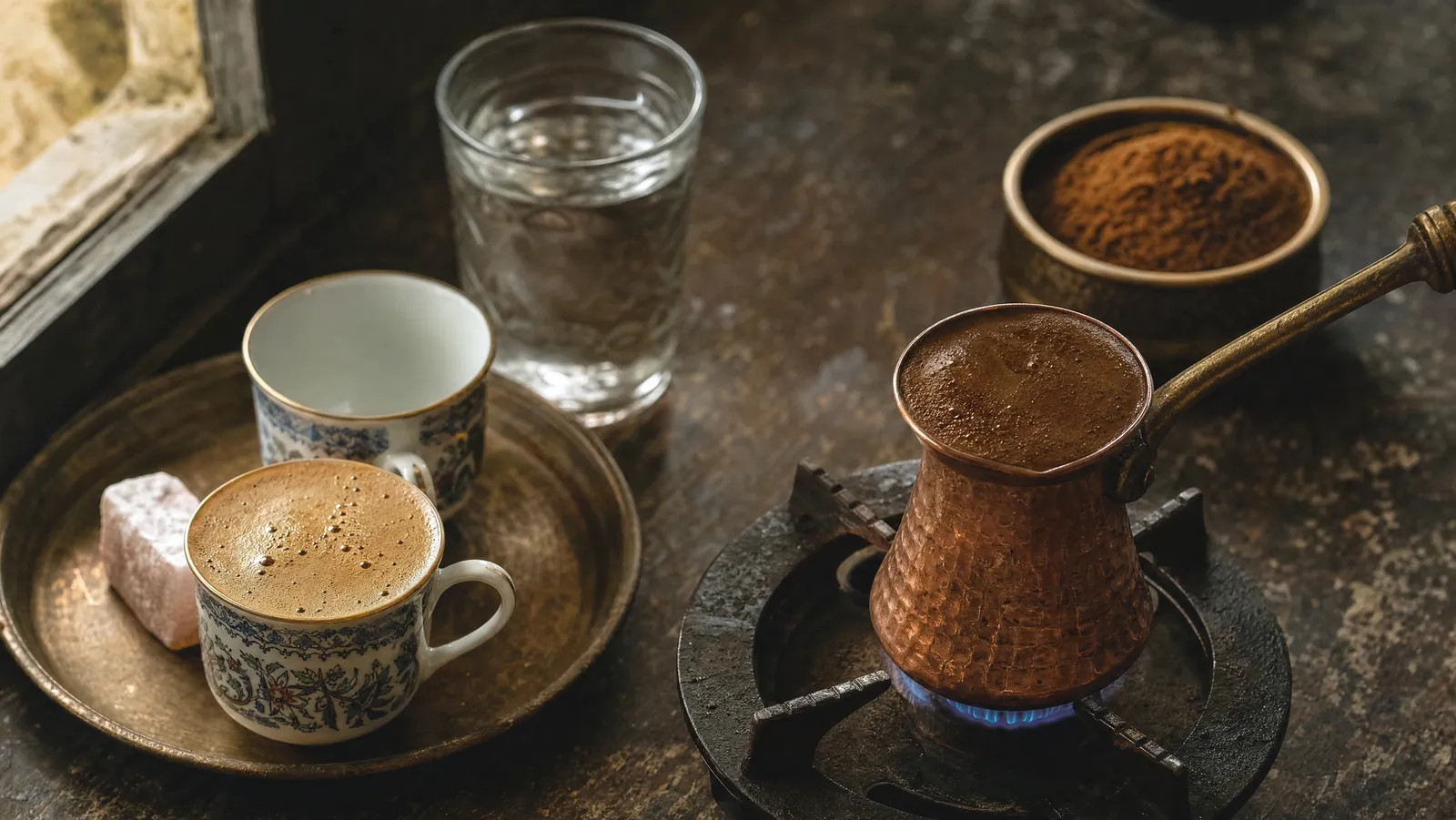
Turkish coffee is unfiltered coffee simmered in a small long-handled pot called a cezve and served grounds and all, with a layer of dense foam on top. Nothing is strained out. The grind is finer than espresso — powder-fine — and the coffee must never reach a rolling boil, because slow heating is what builds that foam and a hard boil destroys it.
Sweeter Grind is reader-supported. We may earn a commission on purchases made through links on this site, at no extra cost to you.
Learning how to make Turkish coffee is mostly learning those two things. There is no bloom to time, no pour to steady, no filter to rinse. You combine cold water, powdered coffee and your sugar in a cezve, bring it up gently, and pull it off the moment the surface domes. It is one of several coffee traditions around the world that produce a serious cup with almost no equipment — and one of the easiest to get wrong.
What Turkish Coffee Is (and What a Cezve Is)
Turkish coffee — Türk kahvesi — is full-immersion brewing that is never separated from its grounds. Powdered coffee goes in with the water, heats until a foam rises, and pours straight into a small cup. The grounds travel with it and settle into a sludge over the next two minutes. You drink the clear coffee above the sediment and leave the last sip behind.
The pot is a cezve (roughly jez-veh), also called an ibrik in parts of the Arab world and the Balkans, a briki in Greece and a džezva in the former Yugoslavia. Its shape is functional, not decorative:
- Narrow neck, wide base. The base takes the heat; the taper concentrates the rising foam into a thick plug instead of letting it spread thin.
- Long handle. You lift this pot off the flame repeatedly, mid-brew.
- Heavy copper, usually tin-lined. Copper spreads heat evenly, and mass slows the temperature climb — which is the entire trick.
Size matters more here than with any other brewer. A half-empty cezve gives the foam too much headspace and too little depth, so buy for the number of cups you actually pour. Good handmade copper runs roughly $25 to $55 as of November 2026. A full roundup of the best cezve and Turkish coffee pots is still to come; the four below cover the sizes that matter.
The Grind: Finer Than Espresso
This is the part people get wrong, and it is not close. Turkish coffee needs a powder. Copenhagen Coffee Lab describes the target as feeling like flour between your fingers and explicitly finer than espresso; Saki's brewing guide uses a "smooth like powdered sugar" test. If the grounds still feel gritty, they are too coarse.
Barista Hustle ran cezve experiments with trainers Diana Dolejsi and Gwilym Davies and reported that grind size affected extraction yield far more than end temperature did — it was the most important variable in the brew. Their tasters preferred a grind only slightly finer than espresso and did not enjoy brews made at the very finest powder setting. So aim for a band: clearly past espresso, smooth to the touch, without chasing the floor of your grinder.
Which raises the real problem. Most home burr grinders cannot get there. Copenhagen Coffee Lab calls grind size the biggest challenge for most people making this at home, and advises that if your grinder will not go finer than espresso you will get a better result from coffee ground specifically for the purpose. Consumer burr grinders are generally built to bottom out around espresso fineness, and many have no setting below it — a design limit, not a defect. Three ways round it:
- Buy pre-ground Turkish coffee. Sold specifically at this grind. Because this is full immersion with no filter, the freshness penalty stings slightly less than in a pour-over.
- Use a hand grinder rated for Turkish. Traditional brass mills reach it, and some modern hand grinders list a Turkish setting. Our comparison of manual versus electric grinders covers the trade-off; manual is the cheaper route to extreme fineness.
- Have it ground at a shop. Ask for "Turkish grind" and buy small amounts at a time.
What not to do is reach for a blade grinder. It chops rather than mills, producing dust and chunks at every setting — the one thing a filterless brew cannot forgive, as we explain in burr grinder versus blade grinder. Our grind size guide shows where Turkish sits on the scale: the extreme fine end, past espresso.
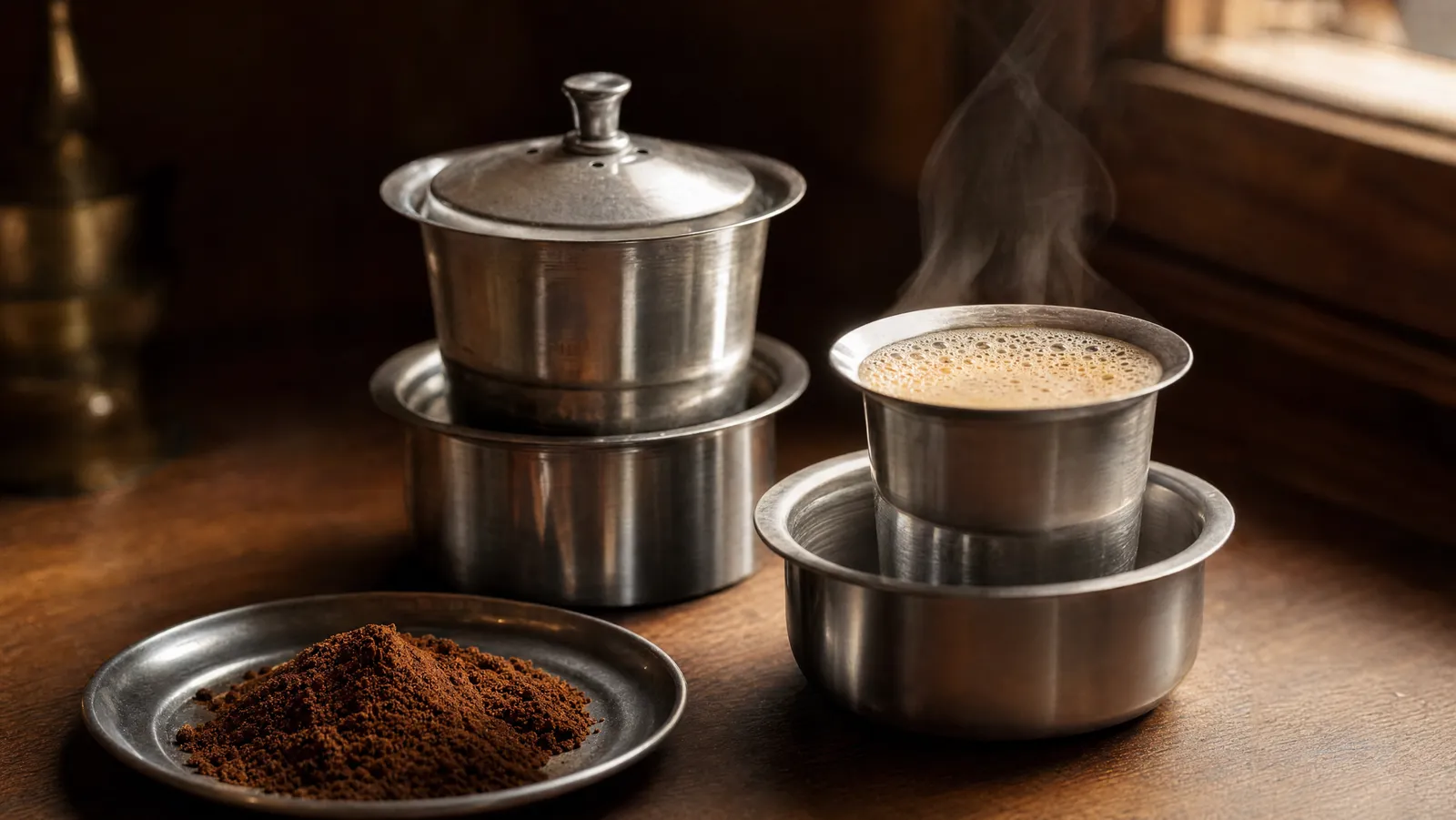
Fine grinds and unfiltered serving are a pattern across traditional brewing, not a quirk. The same logic drives making Vietnamese coffee with a phin.
The Ratio, and the Sugar Decision
Water is traditionally measured with the cup you intend to drink from: fill the demitasse, pour it into the cezve, repeat per person. It scales the dose to the vessel automatically.
For numbers, the range cited across brewing guides is 8:1 to 10:1 water to coffee, with 9:1 the figure that comes up most often. Barista Hustle's cezve work drew on Saudi trainer Sara Alali, who recommends 1:7 to 1:10 depending on roast.
| Servings | Water | Coffee | Notes |
|---|---|---|---|
| 1 | 60-70 ml | 7-8 g | One heaped teaspoon |
| 2 | 120-140 ml | 14-16 g | Wants a 9 fl oz pot — 140 ml overfills a 5 fl oz one |
| 3 | 180-210 ml | 21-24 g | A 9 fl oz pot at its limit; 15 fl oz is easier |
Start at 1:9 — 7 g of coffee to 63 ml of water — and adjust from there. Our brew ratio calculator will scale it to an odd pot size.
The sugar is a rule, not a preference: it goes in before the heat. Turkish coffee is ordered by sweetness level, and the terms are what you will actually hear:
- Sade — plain, no sugar.
- Az şekerli — lightly sweet, about half a teaspoon per cup.
- Orta (often orta şekerli) — medium, about a teaspoon per cup, and the usual default if you do not specify.
- Şekerli — sweet, roughly one and a half to two teaspoons.
The mechanism is simple. Sugar has to dissolve in the cold slurry, because stirring it into a finished cup would break the foam you spent three minutes building. Turkish brewing guides make the point in near-identical words: sweetness is decided at the start and never stirred in later. Two cups at two sweetness levels means two pots.
Water quality shows up clearly here, because nothing is filtered and the cup is tiny. Use filtered water if your tap is noticeably chlorinated.
How to Make Turkish Coffee, Step by Step
Plan on three to four minutes, and stay at the stove for all of it.
Step 1: Measure the water in the cup you will drink from
Fill your demitasse with cold or room-temperature water and pour it into the cezve, once per serving. The cold start gives you the long temperature climb the foam needs. Leave at least a third of the pot empty — the coffee will rise, and with no headspace it rises onto your stove.
Step 2: Add the coffee and the sugar before any heat
Spoon in 7-8 g of powder-fine coffee per cup and add sugar now, at whichever level you want. The pot stays off the burner.
Step 3: Stir the cold slurry once, then stop
Stir until no dry powder is floating. This is the only stirring in the method. Once the pot is on the heat the spoon stays out — Turkish brewing guides are unanimous that stirring during heating collapses the foam.
Step 4: Put it on the lowest heat that works
Low flame, small burner. You want a slow climb, not speed; three minutes is a reasonable target for a small pot, and longer is fine. Watch for a dark ring at the edge, then fine bubbles gathering into a pale brown foam that domes toward the neck.
Step 5: Spoon the first foam into the cups
Just before the foam breaks into a boil — risen and domed, surface not yet churning — lift the pot off. Spoon the foam from the top and divide it between the cups so each gets a share. This is the traditional move, and the reason a good Turkish coffee arrives with a crown.
Step 6: Return the pot for a second rise, then pour
Back on low heat — most guides say about 15-20 seconds, though recipes vary, so watch for the second foam rather than the clock — then pour slowly down the inside of each cup. Pour in two passes when serving several cups, so nobody gets all the sediment.
Step 7: Let the grounds settle for two minutes
Set the cups down and leave them. Sipping immediately gives you a mouthful of silt; waiting gives a clean, syrupy cup with a sludge line you stop at.
The Foam Is a Heat Problem
The foam — köpük — is how a cup gets judged, and it is built almost entirely by how slowly the temperature rises. As the slurry warms, dissolved gas and coffee oils come out of solution and stabilise into a dense, fine-bubbled layer. Give that time and you get a thick crown. Rush it and the bubbles form large, coarse and fragile, then collapse.
A rolling boil ends the story. Boiling agitates the slurry hard enough to tear the structure apart; Saki's brewing notes put it plainly — do not boil the coffee vigorously, because that destroys the foam. There is no recovery: once a cezve boils over, start again.
Three things protect the foam: low heat, no exceptions — rest the pot on a diffuser if your smallest burner still runs hot; no stirring after the heat goes on; and a reasonably full pot, because depth helps the foam hold together. Barista Hustle also observed that a finer grind produced a bigger foam layer.
Serving
Turkish coffee is served in a fincan, a small handled demitasse — sources put the traditional cup at roughly 2 to 3 oz (60–90 ml) — almost always with a glass of water alongside, which is sipped first to clear the palate. Something sweet on the side is common: Turkish delight, a square of chocolate, a biscuit. The etiquette worth importing is the pace — a 2–3 oz cup of unfiltered coffee is not a commuting drink.
Troubleshooting
| Problem | Likely cause | Fix |
|---|---|---|
| No foam, or a thin one that vanishes | Heat too high; stirred after heating; grind too coarse; pot too empty | Drop the heat, keep the spoon out once the pot is on the burner, grind finer, match pot size to the cups poured |
| Bitter, harsh, drying | Over-extraction — too long on the heat, or a dark roast pushed too far | Shorten the time on heat and try a medium roast; FreshCup warns that darker roasts in a cezve can tip easily into overwhelming bitterness |
| Thin, sour, watery | Under-extraction, or too little coffee | Move toward 1:8, and check the grind is genuinely powder-fine |
| Gritty, silty sips | Not enough settling time, or poured too fast | Wait two full minutes, pour slowly, stop drinking at the sediment line |
| Boiled over | Walked away; pot overfilled | Stay at the stove; fill no more than two-thirds |
Bitterness and sourness in a cezve follow the same rules as in any brewer — our guide to coffee extraction covers the mechanism behind both.
A Note on the Tradition
Turkish coffee culture and tradition was inscribed on UNESCO's Representative List of the Intangible Cultural Heritage of Humanity in 2013, at the eighth session of the Intergovernmental Committee. UNESCO's entry opens by describing it as combining "special preparation and brewing techniques with a rich communal traditional culture," and the listing is as much about the social practice — coffeehouse gatherings, family occasions, the method passing down within households — as about the drink.
Around it sit customs that vary by family and region: coffee served at engagement visits, and the widely practised reading of the grounds left in an upturned cup, kahve falı, usually shortened to fal. Accounts of the method's deeper history are not uniform, and we would treat confident origin stories with some caution.
FAQ
Can I make Turkish coffee without a cezve?
Yes, with compromises. Any small narrow-necked saucepan will brew it — a butter warmer or your smallest milk pan is the usual substitute. What you lose is the taper that concentrates the foam and the mass that slows the temperature climb, so expect a thinner crown. A wide pan is the worst case: the foam spreads out and never thickens.
What grind size is Turkish coffee?
Finer than espresso — a powder. Copenhagen Coffee Lab's test is that it should feel like flour between your fingers; Saki's is that it should feel smooth like powdered sugar. Barista Hustle's tasters preferred a grind slightly finer than espresso over the very finest setting available, so aim to be clearly past espresso without bottoming out your grinder. Most consumer burr grinders cannot reach this range at all.
Do you drink the grounds in Turkish coffee?
You drink with them, not through them. The grounds pour into the cup and settle out over about two minutes into a thick layer at the bottom. You drink the coffee above it and stop when you reach it — leaving the last few millimetres is standard, not fussy. It is also what makes the cup readable afterwards in the fal tradition.
How much caffeine is in Turkish coffee?
Modest per cup, because the cups are small, but high per millilitre. Published figures vary with dose, bean and serving size. A survey of caffeine in beverages commonly consumed in Jordan measured Turkish coffee at 146.6 mg per 100 ml against 194.6 mg per 100 ml for espresso, the two highest in that study; on that figure a 60-70 ml serving would land near 90-100 mg. Many consumer sources cite a lower 50-65 mg. Treat any single number as an estimate, not a measurement of your cup.
Is Turkish coffee the same as Greek coffee?
The brewing method is essentially the same: powder-fine coffee simmered unfiltered in a small long-handled pot and served with its grounds. The names and the national traditions differ, and the naming question is genuinely sensitive rather than trivial. NPR's reporting on it quotes Greek food scholar Albert Arouh recalling that when he was a kid in the 1960s everyone in Greece called it Turkish coffee, that he began noticing a name change after 1974, and that by the 1980s it was no longer politically correct to order a "Turkish coffee" in Greek cafes; NPR adds that by the early 1990s Greek coffee companies were advertising the drink under the new name. Accounts of exactly when and why the shift happened differ, and in Cyprus the drink came to be called kypriakos kafes. Greece has its own distinct coffee repertoire alongside it, Greek frappé and freddo espresso among them. We describe the practice and use the name our source or host uses rather than adjudicating it.
Where to Go Next
Turkish coffee rewards attention because so little equipment sits between you and the result. Get the grind genuinely fine, keep the heat low, decide the sugar before you start, and pull the pot before the boil. That is the method; the rest is repetition.
To see how it sits alongside the phin, the moka pot and the other methods that grew up outside the third-wave canon, our complete world coffee guide maps them out.

Hakan Turkish Coffee Pot, 5 fl oz (150 cc)
A handmade copper cezve with a protective tin lining and a brass handle, sized at 5 fl oz (150 cc) — roughly one or two demitasse servings. Hakan states the same pot is offered in six sizes, from this 5 fl oz up to 16 fl oz (475 cc). The right pick if you are the only Turkish coffee drinker in the house and want a pot small enough to build foam on a single cup.

Volarium Hammered Copper Cezve (Small)
Thick hammered copper, handmade, with a food-safe tin lining inside and an engraved brass handle. The heavier wall is the reason to pick it: Turkish coffee depends on a slow, even temperature climb, and mass is what buys you that. Volarium also pitches it as a milk pot, small sauce pan or butter melter, so it earns its drawer space on days you are not making coffee.

DEMMEX Copper Cezve, 9 fl oz (3 Servings)
1mm thick copper with a food-safe tin-lined interior and a wooden handle, handmade and hand-engraved in Turkey. DEMMEX rates it at 9 fl oz for 3 Turkish coffee servings, calculated at 2 oz per cup. This is the size most households should start with — big enough for guests, small enough that a solo cup still has depth.

DEMMEX Large Copper Cezve, 15 fl oz (6 Servings)
The same 1mm copper, tin-lined, hand-engraved build as the smaller DEMMEX, scaled up and shipped with a wooden handle and a spoon. DEMMEX rates it at 15 fl oz for 6 Turkish coffee servings at 2 oz per cup. Buy it if you regularly serve a table, not if you mostly brew for yourself.