Vinegar vs Descaling Solution: Which Should You Use?
 Tommie Chaney·
Affiliate disclosure: Sweeter Grind is a participant in the Amazon Services LLC Associates Program. We may earn commissions on qualifying purchases at no extra cost to you.
Both of them work. That's the part nobody says out loud.
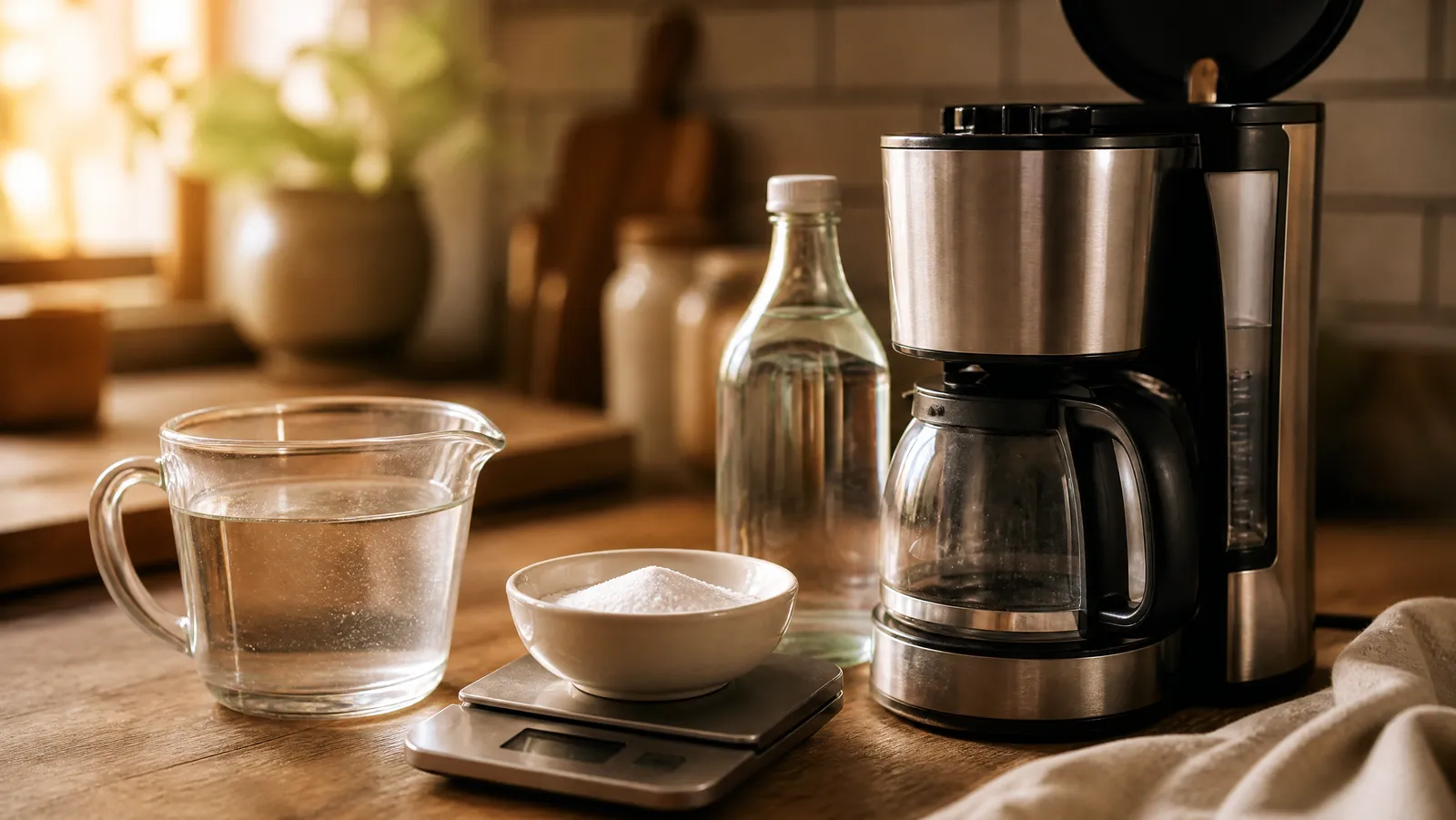
Vinegar and commercial descaling solution both dissolve limescale. Vinegar is cheaper and weaker; commercial descalers are formulated to act faster, rinse cleaner, and treat seals and metal more gently. The deciding factor in vinegar vs descaling solution for a coffee maker isn't chemistry — it's what your manufacturer permits in writing.
And manufacturers do not agree. Cuisinart prints a vinegar ratio in its instruction booklets. Nespresso and JURA both warn against it in their own published documentation. Breville's manual doesn't mention vinegar at all — it just names its own powder. So "check your manual" isn't a cop-out here. It's the answer, because the manuals genuinely say different things. This piece sits inside our broader guide to how to clean and descale coffee equipment; this one owns the choice of acid.
The Short Answer
Use a commercial descaler if your machine has a boiler, is a pod machine, or is still under warranty. That covers espresso machines, super-automatics, Nespresso, and most Keurig brewers.
Vinegar is defensible on a cheap drip brewer or an electric kettle — if the manufacturer's own instructions name it, and if you rinse properly afterward.
If the manual forbids vinegar, that's the end of the conversation. The savings are a few dollars a year. The downside is a repair bill the maker can decline to cover.
What Each One Actually Is
White vinegar is a dilute acetic acid solution. Standard household white vinegar is typically labeled 5% acidity, and at that strength it's relatively mild — heavy mineral crusts may need repeat soaks or overnight contact. According to the American Chemistry Council's Chemical Safety Facts, the acetic acid content of vinegar generally runs about 4% to 8%. "Vinegar" is not one fixed concentration.
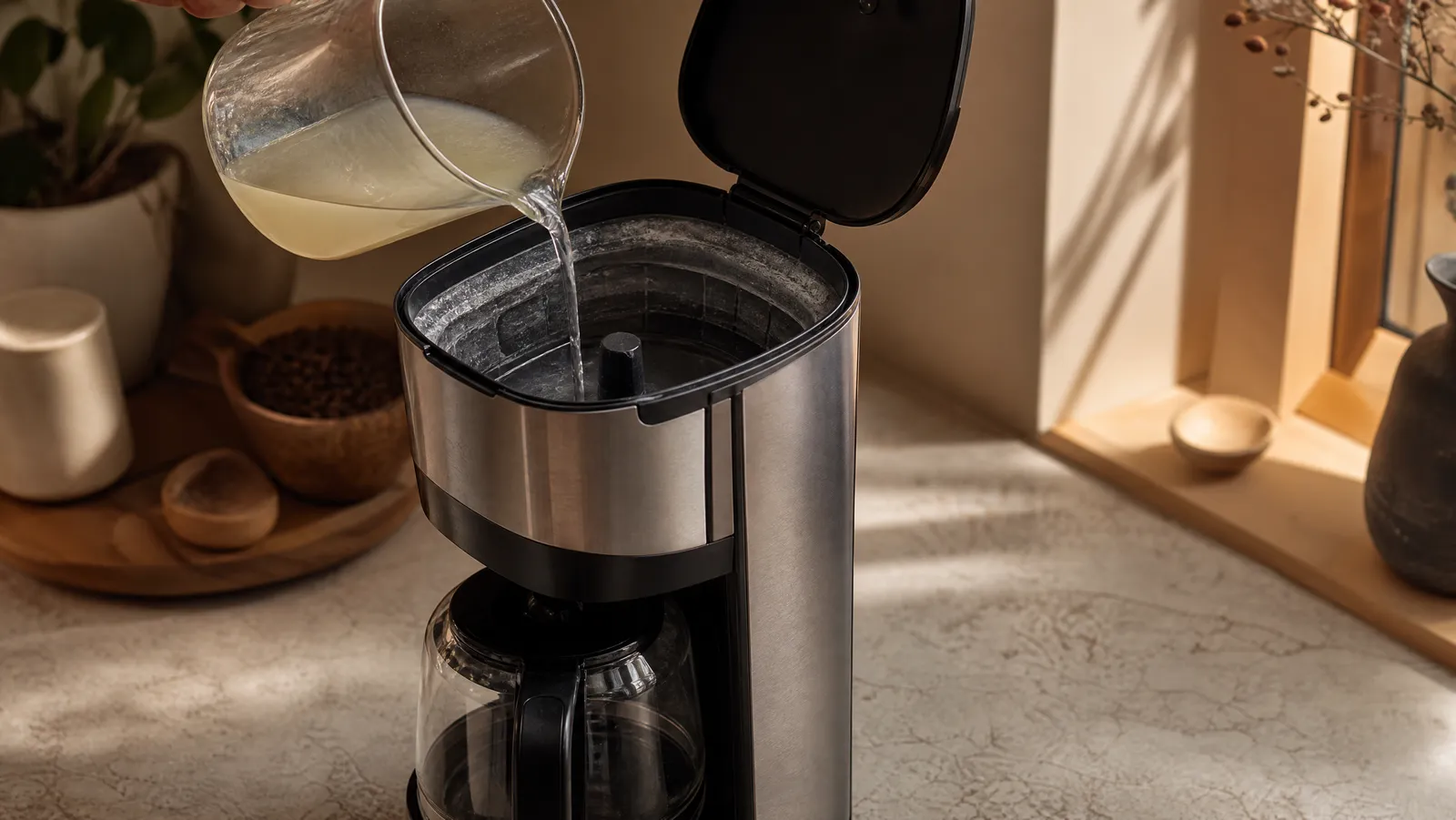
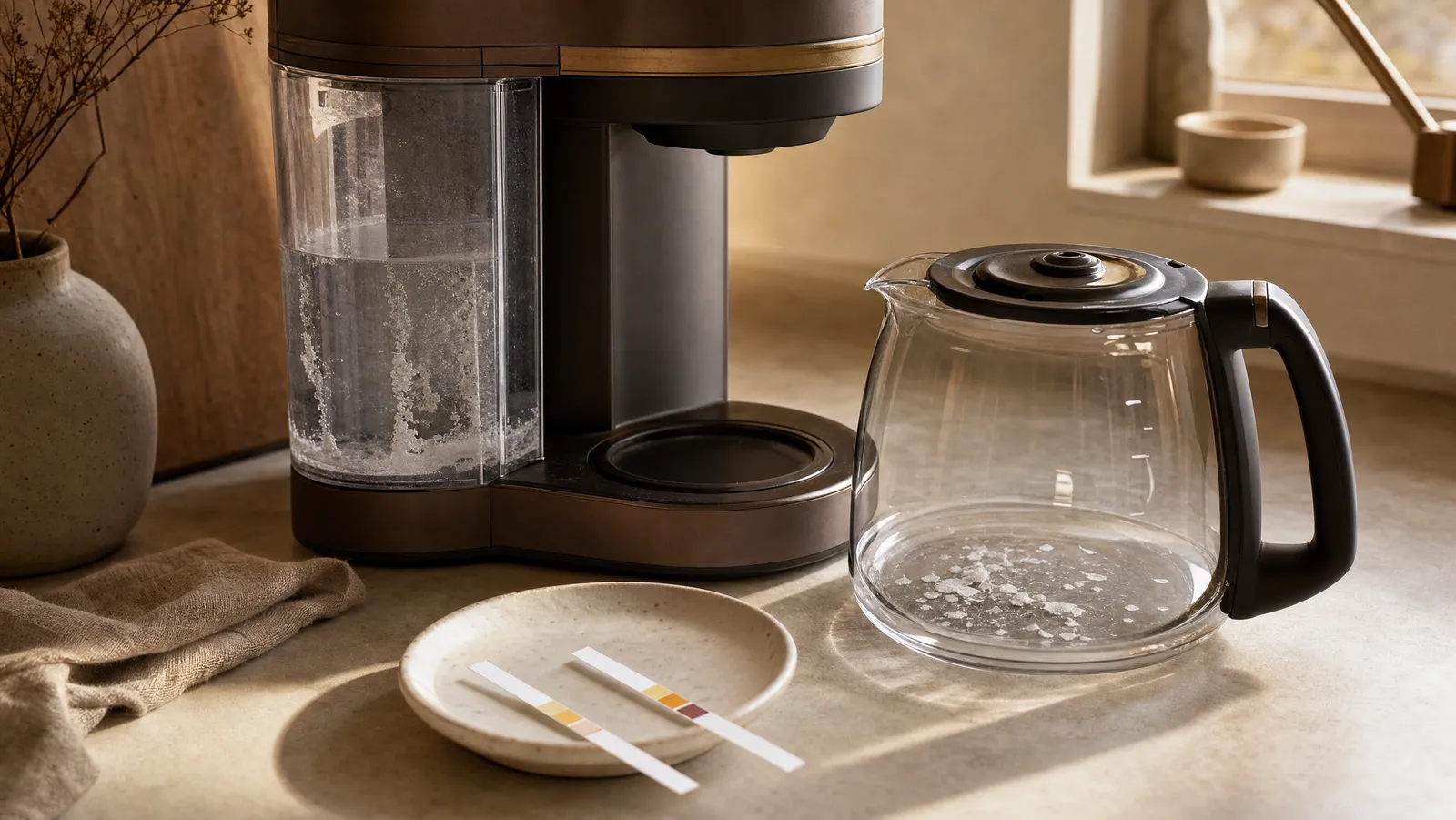
The reaction is straightforward acid–carbonate chemistry: acetic acid meeting limescale (calcium carbonate) produces calcium acetate, carbon dioxide, and water — the chalky deposit becomes soluble and flows out with the rinse.
Commercial descalers use different acids and add things vinegar doesn't have. Urnex's safety data sheet for Dezcal, one of the more common home descaling powders, lists citric acid at 30–60% and sulfamic acid at 1–5%; Urnex's separate ingredient disclosure adds a sodium salt buffer, aluminum sulfate, and hydrated silica. Urnex's own product page claims Dezcal "is odor free and rinses away thoroughly, unlike vinegar which can be difficult to rinse, takes longer to be effective and leaves behind an unpleasant odor and aftertaste" — a vendor claim, and worth reading as one. (Retail listings also describe Dezcal as NSF certified for metal compatibility; we could not find that certification claim on Urnex's own product pages.) De'Longhi's EcoDecalk takes a third route — the company's product page describes it as a plant-based lactic acid formulation, and presents it as the descaler De'Longhi recommends for all its coffee makers.
That's the real difference. Vinegar is one acid in water. A commercial descaler is an acid plus a buffer and other formulation agents, and it's sold as being matched to the alloys and seal compounds used in coffee equipment. A third option we'll cover separately — a DIY citric acid descaling solution made from food-grade powder — lands between the two.
On speed: specialty retailer ECS Coffee argues acetic acid takes substantially longer than citric acid to dissolve the same quantity of scale. We found no peer-reviewed figure behind that, so treat it as directional rather than a spec — but it matches the practical experience that vinegar cycles need a longer dwell.
Head to Head
| Factor | White vinegar | Commercial descaler |
|---|---|---|
| Active acid | Acetic acid, typically labeled 5%; about 4–8% across products (Chemical Safety Facts) | Citric, sulfamic, or lactic acid by brand (Urnex, De'Longhi) |
| Descaling power | Good on light to moderate scale; heavy deposits may need repeat cycles | Built for one dosed cycle; ECS Coffee argues citric beats acetic on speed |
| Additives | None — acid and water | Buffers and processing agents; Urnex's Dezcal disclosure lists a sodium salt buffer, aluminum sulfate, and hydrated silica alongside the acids |
| Cost per descale | Cents — one grocery jug covers many cycles | Priced per sachet; more than vinegar, still small annually |
| Seals and gaskets | Nespresso and JURA both warn in writing that non-approved agents such as vinegar may damage the machine | Formulated around the maker's own seal compounds |
| Rinse-out | Varies by maker: Cuisinart's booklet says one cycle, Bean Box says two to three, Keurig's legacy vinegar instructions said four | Typically one tank; Breville's BES870 manual specifies one |
| Warranty position | Warned against by some brands, printed as the instruction by others | The safest position — it's the maker's own named product |
| Smell | Strong and lingering — the classic failure mode | Effectively none |
| Availability | Every grocery store | Online and appliance retailers |
Where Vinegar Wins
Vinegar earns its place in a narrow band, and it's a real one.
Cheap drip machines whose makers already endorse it. If your brewer's booklet prints a vinegar ratio, buying a branded sachet is spending money to solve a problem you don't have. Our roundup of the best automatic drip coffee makers covers the segment where this is most often true.
Electric kettles. A kettle is a vessel and a heating element. No seals under pressure, no solenoid valves, no narrow tubing. Vinegar and heat handle it.
Occasional, low-frequency descaling. Most of the concern about acetic acid centers on repeated exposure over years. The brands that warn against vinegar describe the risk as cumulative rather than instant — JURA's manual, for example, warns only that non-recommended agents "may contain substances that could damage the machine or leave residues," and specialty-retailer coverage points at rubber seals and gaskets specifically. Twice a year on soft water is a very different exposure profile from every six weeks on hard water.
Budget genuinely being the constraint. A descaled machine beats an un-descaled one, always. If the choice is vinegar or nothing, and the manual doesn't forbid it, use the vinegar.
One hard safety line, regardless of machine: never mix vinegar with bleach or any chlorine-based cleaner. Combining sodium hypochlorite with an acid releases chlorine gas. As reported by TODAY, citing America's Poison Centers' National Poison Data System, US poison centers logged roughly 4,800 single-substance chlorine gas exposures in 2021 — defined as mixing a household acid product with bleach. If it happens, leave the area and call Poison Control at 1-800-222-1222.
Where a Commercial Descaler Wins
Espresso machines. Boilers, pressurized solenoid valves, group-head gaskets, three-way valves. There are more seals in a semi-automatic espresso machine than in a drip brewer's entire assembly, and they're the parts vinegar guidance keeps warning about.
Pod machines. Nespresso and Keurig systems run tight internal water paths and proprietary valve hardware, and both brands sell their own descaling products for a reason.
Machines whose makers name their own product. De'Longhi's own maintenance guidance is blunt: "Use the De'Longhi descaler and never vinegar!" The reason the company itself gives is taste — it says vinegar "is prone to leave a strong smell and an acid taste to your coffee" — and it points owners at EcoDecalk. Third-party repair coverage adds that acetic acid can attack aluminum and seal materials over time, though we could not find De'Longhi making that specific corrosion claim. If you don't know what metal your boiler is, that uncertainty argues for the formulated product.
Anything under warranty. The unglamorous one. A sachet costs less than a service call, and it removes the argument entirely.
Hard-water households on a frequent schedule. Water hardness drives how fast scale forms, and therefore how often you make this decision at all — our guide to why water quality matters for coffee covers the mineral side. If you're descaling every six to eight weeks, cumulative acid exposure stops being theoretical. Frequency matters as much as which acid you pick, which is why how often you should descale your coffee maker is its own question.
Manual brewers sit outside this debate entirely. A French press, AeroPress, or V60 has no heated water path to scale up — they need a different kind of cleaning, aimed at coffee oils rather than minerals.
What Manufacturers Actually Say
This is the section that should decide it for you. We pulled these from published manufacturer material where we could reach it, and from reporting on that material where we couldn't.
| Brand | Published position on vinegar |
|---|---|
| Cuisinart | Instruction booklets tell owners to decalcify with white vinegar and water. The PerfecTemp DCC-3200 booklet says to "fill the water reservoir to capacity with a mixture of 1⁄3 white vinegar and 2⁄3 water," then run the CLEAN cycle |
| Breville | The Barista Express (BES870) manual specifies one Breville descaling powder sachet in 34 fl oz (1 L) of water. The word "vinegar" does not appear anywhere in it |
| Nespresso | Nespresso's official descaling guides say machines "should be descaled with a Nespresso Descaling Kit," and that "other solutions (such as vinegar or store-bought descalers) may cause damage to your Nespresso machine" |
| JURA | JURA's instructions for use carry a warning: "Non-recommended descaling agents (e.g. vinegar) may contain substances that could damage the machine or leave residues. Use only original JURA descaling tablets" |
| De'Longhi | "Use the De'Longhi descaler and never vinegar!" The reason De'Longhi gives is that vinegar "is prone to leave a strong smell and an acid taste to your coffee"; it points owners to EcoDecalk, a plant-based lactic acid formula |
| Keurig | Current Use & Care guides specify Keurig Descaling Solution and don't mention vinegar. But Keurig's own legacy de-scaling instructions for the B31, B40, B44, B60 and B70 brewers call for undiluted white vinegar — which is why advice online still looks split |
Three things follow from that table.
First, do not generalize one brand into "manufacturers say." Cuisinart printing a vinegar ratio does not make vinegar safe in a JURA. The machines aren't built the same way.
Second, absence of a prohibition is not permission. We read the Breville BES870 manual directly. It neither permits nor forbids vinegar — it specifies Breville's own powder and a dosing amount. That's an instruction designed around a product, not an endorsement of alternatives.
Third, warranty exposure is real but brand-specific. We found no blanket "vinegar voids all warranties" rule, and you should distrust anyone who states one. What we did find is several brands naming their own product in writing, plus warranty text like Keurig's, which states that the limited warranty does not cover "damages caused by use of non-Keurig® pods or accessories." Whether a supermarket jug of vinegar counts as an "accessory" is exactly the argument you don't want to be having. In warranty, the cheap move is the branded sachet.
Once you've picked your agent, the mechanics are the same either way — dose, run, dwell, rinse. We walk that through in how to descale a coffee maker.
The Rinse Problem
Here's the failure mode nobody warns you about until it's in your cup: vinegar doesn't leave quietly.
Published rinse guidance for vinegar clusters around two to three full fresh-water brew cycles, and sometimes more. Bean Box advises running two plain-water cycles, "three if you can still smell it." Keurig's own legacy vinegar instructions were stricter still: a fresh-water cleansing brew, then "repeat this cleansing brew process three (3) more times to cleanse the Brewer plumbing and to remove any residual vinegar taste." Cuisinart's DCC-3200 booklet, at the other end, calls for a single fresh-water cycle. Follow your own manual — but if it's silent, err high. That's not a formality. Acetic acid clings to plastic reservoirs and silicone tubing, and a half-hearted rinse produces coffee with a sour edge that people routinely misdiagnose as bad beans or a bad grind.
Commercial descalers are formulated to rinse out in fewer passes, and the manuals reflect that. The Breville BES870 manual calls for rinsing the tank, refilling to the full 68 fl oz (2 L), and running one more complete cycle to clear residue — one pass, not three.
Do that arithmetic on a 12-cup brewer. What you save on the sachet, you spend in time and electricity — and if you skip the rinses to save that time, you've traded a scale problem for a taste problem.
Frequently Asked Questions
Can I descale with lemon juice?
It's citric acid — the same acid family used in commercial descaling powders. Urnex's safety data sheet lists citric acid at 30–60% of Dezcal, its largest single component. But lemon juice also carries sugars and pulp you don't want in a water path, and its acid concentration is inconsistent bottle to bottle. Food-grade citric acid powder is the better version of this idea. Lemon juice is not.
Does apple cider vinegar work for descaling?
Chemically it's still acetic acid, so it will dissolve scale. But it's colored, it carries sugars and sediment white vinegar doesn't, and the residual smell is worse. Every manufacturer instruction we found that names vinegar specifies white vinegar.
Can I use baking soda to descale a coffee maker?
No. Baking soda is a base, and limescale removal is an acid job — opposite ends of the pH scale. It's useful for scrubbing stains off a carafe. It will not dissolve mineral scale inside the water path.
Is CLR safe in a coffee maker?
Sometimes — and CLR itself is specific about when. CLR Brands publishes coffee maker instructions (one part CLR to eight parts water for a 10–12 cup automatic drip machine, followed by two full clear-water cycles), but it also states the product is "not recommended for Gevalia, Keurig or Cuisinart coffee makers," should not be used in machines that hold water permanently, and should not be used in espresso machines at all. CLR's own advice is to read your coffee maker's manufacturer directions first to confirm compatibility. That is the rule we'd follow.
Will vinegar ruin the seals in my coffee maker?
Not in one use, and not on every machine — and the manufacturers who warn against vinegar are vaguer about the mechanism than the internet is. JURA's manual says only that non-recommended agents "may contain substances that could damage the machine or leave residues." Nespresso says other solutions "may cause damage to your Nespresso machine." De'Longhi's stated objection is smell and taste, not corrosion. The seal-and-gasket explanation comes mostly from specialty retailers and repair shops rather than from the makers themselves. The honest read: the warnings are real and worth heeding, the risk is cumulative rather than instant, and it is far higher on machines with pressurized seals than on a drip brewer or kettle.
How many rinse cycles do I need after descaling?
Start with what your own manual says — published guidance ranges from Cuisinart's single fresh-water cycle to the four that Keurig's legacy vinegar instructions called for. If the manual is silent, plan on two to three full fresh-water cycles and then use your nose: if you can still smell vinegar, run another. For a commercial descaler, follow the manual; Breville's BES870 instructions call for a single full-tank rinse cycle after the descaling passes.
The Verdict
Both lazy answers are wrong. "Vinegar is fine, it's just acid" ignores that acetic and citric acid behave differently against the seals and metals in your specific machine. "Always buy the branded stuff" ignores that Cuisinart prints a vinegar ratio in its own booklets.
The real answer is conditional, and the condition is short enough to memorize: open the manual, find the descaling section, do what it says. If it names vinegar, vinegar is fine — then rinse for as many cycles as the manual specifies, and keep going until you can't smell it. If it names a descaler, buy the descaler. If it says nothing about vinegar and the machine has a boiler, a pump, or a warranty, use the descaler anyway.
Then get the frequency right, because a machine descaled once a year with the wrong acid beats one descaled with the right acid never. For everything neither agent fixes — oils, mold, grinder residue, the parts you can actually see — our complete guide to cleaning coffee equipment covers the rest of the job.
Related reading
- How to Descale a Coffee Maker (Step by Step) — the full procedure once you've picked your agent
- How Often Should You Descale Your Coffee Maker? — intervals by machine type and water hardness
- Why Water Quality Matters for Coffee — the mineral content that creates scale in the first place
- How to Clean Manual Brewers: French Press, AeroPress, Pour Over — no water path, different job entirely
- The Best Automatic Drip Coffee Makers — where a vinegar-friendly manual is most common