How Often Should You Descale Your Coffee Maker?
 Tommie Chaney·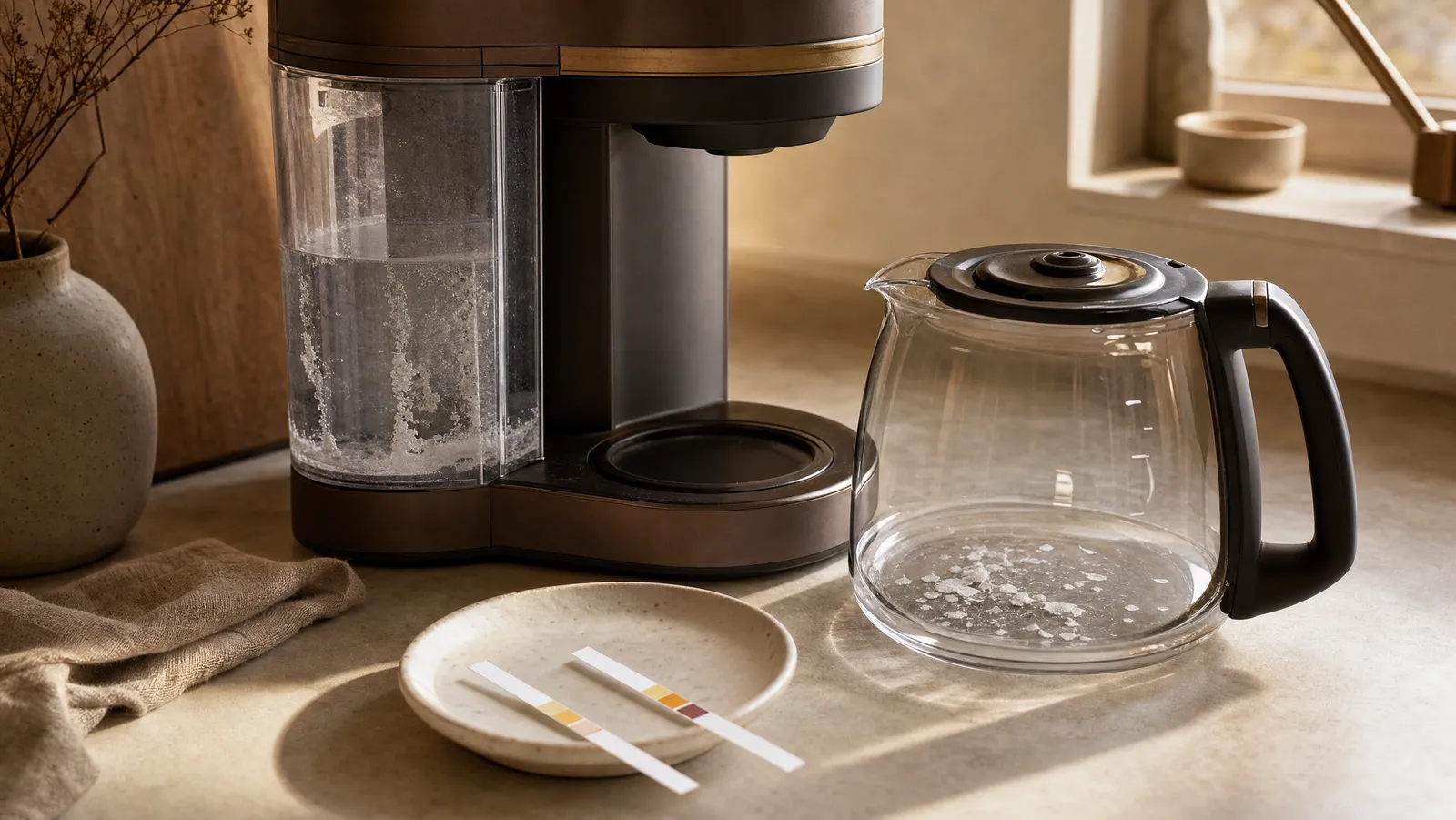
Affiliate disclosure: Sweeter Grind is a participant in the Amazon Services LLC Associates Program. We may earn commissions on qualifying purchases at no extra cost to you.
Descale your coffee maker somewhere between once a month and twice a year, depending on your water. Most manufacturers print "every three months." That figure is a guess at an average household on average tap water — and almost nobody is average. A soft-water house brewing two cups a day and a very-hard-water house brewing eight are a factor of six apart.
Here's how to turn that average into a number for your own kitchen: hardness first, volume second, warning signs override both. It's the when half of the larger job of cleaning and descaling coffee equipment — the sibling guides own the how. Check your manual first; some machines have requirements that trump general advice.
The Short Answer, by Water Hardness
Water hardness is the biggest variable. According to the U.S. Geological Survey, hardness is "the amount of dissolved calcium and magnesium in water," classified in four bands measured as milligrams per liter of calcium carbonate. One grain per gallon (gpg) equals roughly 17.1 mg/L.
| USGS classification | mg/L as CaCO3 | Grains per gallon | Suggested descaling interval |
|---|---|---|---|
| Soft | 0–60 | 0–3.5 | Every 6 months |
| Moderately hard | 61–120 | 3.5–7 | Every 3–4 months |
| Hard | 121–180 | 7–10.5 | Every 2 months |
| Very hard | 180+ | 10.5+ | Monthly |
The bands are the USGS's. The intervals are ours — built from where the major manufacturers land, then scaled by hardness. Treat them as a starting point and adjust for volume below.
What the Manufacturers Actually Publish
Here's the detail that reframes the question: brands that publish a number mostly publish a cycle count, not a calendar date. The months are just that count divided by a hypothetical average user.
| Brand | Published guidance |
|---|---|
| Nespresso | Every 3 months or 300 capsules, whichever comes first |
| Keurig | Every 3 months for average use; support guidance says 3–6 months or when the descale light appears. The K-Slim +ICED use and care guide describes an alert after 250 brews |
| De'Longhi (pump espresso) | Support FAQs cite roughly 200 uses, adjusted for local hardness; many models can be programmed to a hardness setting |
| Cuisinart | The Clean indicator flashes when it's time; third-party guides translate this to every 3–6 months depending on use and water |
| Breville | No universal calendar interval; the machine prompts you — Breville's own guide says "the LCD will indicate when a descale cycle is needed." Breville does publish a water-filter schedule: every 90 days or 10.6 gallons |
Note the spread. Nespresso's 300 capsules, Keurig's 250 brews and De'Longhi's ~200 uses are three different thresholds from companies that all landed on the same honest unit: water volume through the machine.
Why Water Hardness Sets the Schedule
Scale isn't dirt. It's dissolved calcium and magnesium coming out of solution and crystallizing onto whatever surface is hottest — the heating element, the boiler wall, the narrow tubing on the way to the shower head.
Hard water carries more of it. Water at 180 mg/L carries roughly three times as much dissolved mineral per liter as water at 60 mg/L — three times as much left behind — which is why a machine in Phoenix and an identical machine in Seattle can be in completely different condition after a year of identical use. Nothing about the machine changed. The water did.
Which makes descaling frequency and "what water makes better coffee" the same question wearing two hats. Minerals extract coffee; minerals also wreck machines; the useful range is narrower than most tap water. Our guide to why water quality matters for coffee covers the taste side — read it before changing your supply, because softening for scale and optimizing for flavor aren't the same move.
How to Find Your Water Hardness
Three ways, in ascending order of effort:
- Hardness test strips. Run the cold tap briefly, dip, compare to the color chart. Home water-testing guides put most kits under $20 and are candid that strips sort you into a hardness band rather than giving an exact figure — plenty for choosing between "every two months" and "every six." (Drop-titration kits are the more precise option if you want a real number.)
- Your municipal water quality report. On city water the number often already exists: under the EPA's Consumer Confidence Report Rule, every community water system must deliver an annual water quality report to its customers. Hardness isn't a required line item, but many utilities include it. Search your utility's name plus "water quality report."
- The regional picture. The USGS publishes national water-hardness data — a rough check on whether you live in a hard-water part of the country, not a substitute for testing your own tap.
There's also the old soap test: shake pure liquid soap in a bottle of tap water and see whether you get suds or a cloudy scum. Water-testing guides treat it as a yes/no indicator, not a measurement.
Volume Matters Too
Hardness sets the deposit rate per liter. Volume sets how many liters. Eight cups a day pushes four times the water through the same boiler as two, and scales roughly four times faster.
The baseline table above assumes an ordinary household — call it three to five cups a day. Adjust from there:
| Daily brewing volume | Adjustment to baseline |
|---|---|
| 1–2 cups | Stretch the interval by about half again |
| 3–5 cups | Use the baseline as published |
| 6–8 cups | Halve the interval |
| 9+ cups, or an office machine | Cut to a third, and track by cycle count instead |
Worked example. Hard water at 150 mg/L gives a two-month baseline; eight cups a day halves it; your real interval is monthly. Or: soft water at 40 mg/L gives six months, two cups a day stretches it further, and any guide pushing quarterly is costing you time and descaler.
This is a rule of thumb, not a law — nobody has published a calibrated model of scale accumulation for home coffee makers, and we haven't tested one. All it does is stop you applying one number to wildly different usage, which is the exact failure mode of "every three months."
Signs Your Machine Needs Descaling Now
Any of these override the calendar:
- The brew cycle takes noticeably longer. Scale narrows the water path. A drip machine that finished in five minutes and now takes eight is telling you something.
- Sputtering, spitting or gurgling that wasn't there before, especially on pod and espresso machines.
- White or gray flakes in the carafe or the bottom of the cup.
- The coffee is cooler than it used to be — same machine, same mug.
- The taste flattens. Thinner, more sour, less sweet: under-extraction from a boiler that can no longer hit temperature.
- The descale light comes on. Worth acting on, with a caveat.
That caveat: on many machines the alert is a counter, not a sensor. Breville-focused maintenance guides describe it as triggering after a set number of brew cycles rather than detecting actual buildup, which is why it can fire early on soft water and late on hard. Some machines let you set a hardness level, which changes how fast the counter runs. Mechanisms vary — check your manual.
If you've concluded you're overdue, the procedure is in how to descale a coffee maker.
By Machine Type
| Machine | Typical interval on moderate water | Notes |
|---|---|---|
| Drip coffee maker | 3–4 months | Largest reservoir, most volume; usually the first machine in the house to show symptoms |
| Pod / single-serve | 3 months | Nespresso publishes 3 months or 300 capsules; Keurig is broadly quarterly |
| Espresso machine | 2–3 months | Small boiler, high heat, tight tolerances — least forgiving of neglect |
| Electric kettle | 1–3 months | De'Longhi's kettle guidance suggests monthly on particularly hard water, every three months on very soft |
Espresso deserves a note. Descaling is only half of espresso maintenance, and the less frequent half — backflushing to clear coffee oils runs weekly or daily, entirely separate from the mineral problem. If your machine has a three-way solenoid valve, how to backflush and maintain an espresso machine covers that schedule. Some prosumer machines with brass boilers also carry guidance discouraging aggressive descaling.
Grinders aren't on this list, deliberately. Grinder cleaning is an oils-and-fines problem, not a mineral one, and runs on its own clock — see how to clean a burr grinder. Still assembling a setup? Start with our complete coffee equipment guide.
What to descale with. Commercial descaler and diluted white vinegar both work, but some manufacturers advise against vinegar and warn it can void the warranty — see vinegar vs. descaling solution for coffee makers. Whichever you use, never mix cleaning products together.
What Happens If You Skip It
Not much, for a while. That's the trap — scale accumulates invisibly and the symptoms arrive all at once.
The first casualty is flow. Equipment-service guidance consistently describes limescale narrowing internal water channels, showing up as longer brew cycles and weaker pump pressure. The second is heat: scale conducts heat poorly compared to the metal it forms on, so descaler makers and appliance-service guides describe a scaled element as running longer and hotter to deliver the same water temperature — and often failing to reach target at all.
That matters for the cup, not just the machine. Brewing well below the National Coffee Association's recommended 195–205°F window produces coffee that tastes sour and thin no matter how good the beans are. People replace a coffee maker over this when what they needed was an hour and a bottle of descaler.
Eventually, service guidance suggests, a heavily scaled element or pump can fail outright. We can't put a timeline on that — but it's why manufacturers tie descaling to warranty terms.
Frequently Asked Questions
Can you descale a coffee maker too often?
Yes. Descaling agents are acids, and there's no benefit to running one through a machine with nothing to dissolve. Some machine makers and service specialists — particularly around espresso machines with brass or copper components — caution against unnecessary descaling cycles, and some prefer that boiler descaling be done by a technician. Match the interval to your water rather than descaling on a hunch.
Does using filtered water mean I can skip descaling?
No, but it stretches the interval. A carbon pitcher or in-machine charcoal filter mainly targets chlorine and taste and removes only some hardness; filters designed to reduce scale do more. Guidance from filter and softener manufacturers is consistent that filtration reduces buildup rather than eliminating it.
What about softened water — doesn't that solve it?
Partly. Conventional ion-exchange softeners swap calcium and magnesium for sodium, which is why softened water forms far less scale — but softened is not the same as low-mineral, and the dissolved solids are still there in another form. Water-softener manufacturers such as Harvey say softened water means descaling less often, not never. It also changes how coffee extracts.
Does bottled or distilled water mean never descaling?
Distilled and reverse-osmosis water contain essentially no dissolved minerals, so they won't deposit scale. The problem is everything else: very low-mineral water extracts coffee poorly, and some machines rely on water conductivity for their level sensors. Most bottled spring water isn't low in minerals anyway — check the label.
Does the descale light mean my machine is actually scaled?
Not necessarily. On many machines the alert is a brew-cycle counter, not a sensor reading actual buildup. It's a reasonable prompt, but on very hard water you may need to descale before it appears, and on soft water you may be descaling a clean machine.
Is limescale in my coffee dangerous to drink?
Water and health authorities generally treat it as a nuisance rather than a hazard. The World Health Organization has reported no convincing evidence that hard water causes adverse health effects, and notes that calcium and magnesium in drinking water contribute to dietary intake of those minerals. The U.S. EPA sets no drinking-water standard for hardness at all: it is absent from the health-based primary regulations and appears in the non-enforceable secondary guidelines only as a noted aesthetic effect of total dissolved solids. So the case for descaling is taste and equipment life, not safety. If you have a specific medical concern about mineral or sodium intake, that's a conversation for your doctor.
The Formula, One More Time
Start with your water: soft is six months, moderately hard three to four, hard two, very hard monthly. Adjust for volume — halve it at six to eight cups a day, stretch it at one or two. Then let symptoms override both, because a longer brew cycle and cooler coffee are better evidence than any calendar.
One test strip and thirty seconds of arithmetic replaces a number that was never about your kitchen. Once you have your interval, Sweeter Grind's coffee equipment cleaning guide covers the rest of the maintenance calendar — and your manual remains the final word on your machine.
Related reading
- How to Descale a Coffee Maker (Step by Step) — the full procedure
- Vinegar vs. Descaling Solution for Coffee Makers — which agent, and which machines forbid vinegar
- How to Backflush and Maintain an Espresso Machine — the far more frequent espresso routine
- Why Water Quality Matters for Coffee — the minerals that extract coffee and the ones that ruin machines
- How to Clean a Burr Grinder — oils and fines, a different schedule entirely